George Brett
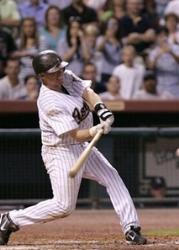
Line-drive hitting George Brett was "The Franchise" for the Kansas City Royals during most of their first twenty-five years of existence. A line-drive hitting menace, he seriously challenged the coveted .400 batting mark in 1980, and collected more than 3,000 hits in his career. He was one of the greatest post-season performers in baseball history and the first Royal inducted into the Hall of Fame. |
Full bio ⇓
Played For
Kansas City Royals (1973-1993)
All-Time Rankings
George Brett ranks #3 among the Top 50 all-time at 3B. Rankings ⇒
Best Season: 1980
Brett won the AL MVP and the Sporting News Player of the Year Award for his 1980 season. His assault on a treasured baseball standard (the .400 mark) also vaulted him into the status as the game's best and most feared hitter and a future Hall of Famer. He also became one of the few batters to ever drive in more runs (118) than games played (117). Brett led the league in batting, slugging, OBP, OPS and Total Average in 1980, the last player to do so in the AL.
Factoids
After George Brett lined a single for his 3,000th career hit, he was picked off first base by Angels' pitcher Tim Fortugno.
Full Bio
Brett came from a baseball family. His older brother Ken pitched thirteen years in the majors while two other brothers played minor league ball. Yet his own beginnings in professional baseball were modest. He batted .281 over three-plus seasons in the minors. He led the California League in errors at third base in his second pro season. He hit only .125 in his first major league call-up in 1973, and hit but two home runs with 47 RBI in his first full season with Kansas City in 1974.
In an effort to boost Brett's average, Royals batting coach Charlie Lau worked with Brett on hitting to all fields on every type of pitch. Brett soon learned to adapt to any pitch, instead of merely waiting to crush fastballs. Meanwhile, Hal McRae, acquired by the Royals the year Brett came up, taught him aggressive base running. The results spoke for themselves: Brett led the American League in hits and in triples in 1975. His batting average climbed to .308.
When he first arrived in the big leagues, Brett was a California playboy. He gained a reputation in his early days for partying. His drinking buddies were Clint Hurdle, Pete LaCock and Royals coach Charlie Lau. It took George a while to settle down - he didn't marry until he was a veteran.
Stellar batting statistics became the norm for Brett. He captured his first batting title in 1976 in controversial fashion, when he battled pre-eminent AL batting leader Rod Carew and fellow Royal Hal McRae for the American League batting crown. Finishing the season against Carew's Twins in KC, the race was a toss-up entering the final game. The events of the final day were bizarre, and when the smoke cleared, only one batter would claim the crown.
Carew, Brett and McRae all had two hits entering the ninth inning. The two Royals were due up in the bottom of the inning. A hit by either and an out by the other would give the title to the Royal batter. Brett batted with McRae waiting on deck and sliced a drive toward left field that Steve Brye misplayed. The ball rolled to the warning track and Brett circled the bases for an inside-the-park home run. This ended Carew's hopes, but if McRae could hit safely he would still win the title by a narrow margin. The Royal DH grounded out however, and Brett won his first batting crown.
But the fireworks were just beginning. As McRae left the field he began motioning to the Twin dugout and particularly at manager Gene Mauch. Mauch quickly answered McRae's tirade with one of his own. McRae accused Mauch of ordering his fielders to allow Brett a hit, thus ensuring the title be won by a white man. The ensuing furor wasn't helped by the strange play of Brye on the ball hit by Brett. For his part Brett shied from the controversy, with Carew and McRae later acknowledging that he deserved to win the title.
In 1979, Brett tallied 85 extra-base hits and was only the sixth player ever (Willie Mays was the last) to collect 20 or more doubles, triples and home runs in the same season. In 1980, he began the season innocently, hitting .255 as late as May 22. But from that day forward he hit a sizzling .427 and took the baseball world on an exciting ride in pursuit of the elusive .400 mark. Though he missed 37 games prior to the All-Star break due to injuries, Brett climbed up the batting charts. Not since Ted Williams in 1941 had anyone hit .400 for a season, but it became evident by August that Brett was intent on doing so.
He hit .472 in June, an amazing .494 in July, and .430 in August. From July 18 to August 18 he hit in 30 consecutive games, a Royal record. His unbelievable success prompted his hitting mentor Charlie Lau to proclaim, "I feel like Dr. Frankenstein watching his monster on the loose."
On August 17, Brett went 4-for-4 against the Blue Jays, running his hitting streak to 29 games. But more impressively he had boosted his average to .401. The next day he stroked three more hits and stood at .404. A little over a week later, a five-hit performance in Milwaukee raised his mark to .407 - the highest level he would reach.
As the chase intensified, so too did the media crunch around Brett. Everywhere the team went Brett was the center of attention. In the Midwest "Brett For President" bumper stickers began to appear. The Royal star granted hundreds of interviews before he finally had to set up daily press conferences to handle the demand. "I just don't know how to handle all this media", Brett said, "In the clubhouse it's embarrassing. The guys must be getting tired of this."
In fact, the Royals were still playing good ball and running away with the AL West flag. But in an ironic way this led to more attention for Brett, since the division race was already determined.
Brett entered September batting .403 and nursing a sore wrist. The injury placed a burden on Brett in several ways. First, he needed to be healthy to make his charge at .400. But he also needed to rest his wrist so it would heal for the post-season. But any rest might appear as if he was trying to "nurse" his batting average. On top of that, due to his first-half injuries, Brett needed to play to ensure enough plate appearances to qualify for the batting title.
Faced with all these pressures and placing pressure on himself as well, Brett began to press and his average dropped. His last day above .400 was September 19. His mark dipped as low as .384 before he rallied late to finish at .390 - the highest level for any batter in 39 years and the highest ever by a third baseman.
Brett readied himself for the post-season but the failure to hit .400 frustrated him when the regular season concluded. "I started to swing at bad pitches. If we hadn't clinched the division so early, the other teams might have been a little more fair to me. But their pitchers just seemed to care about giving George Brett an 0-for-4."
Brett’s clutch hitting was evident that 1980 season as he hit .466 with runners in scoring position – the highest mark ever recorded since that stat was first tracked. No batter has matched it since.
Brett won the AL MVP and the Sporting News Player of the Year Award for his 1980 season. His assault on a treasured baseball standard also vaulted him into the status as the game's best and most feared hitter and a future Hall of Famer. He also became one of the few batters to ever drive in more runs (118) than games played (117). One wonders what might have been had Brett been healthy. He suffered through a bruised heel, tendonitis and torn ligaments that summer. However, the highlight of his season was not capturing the batting title - it was capturing the AL pennant. Brett's upper-deck homer off Goose Gossage in the top of the seventh inning in Game Three of the playoffs sealed a three-game sweep of the New York Yankees.
Despite Brett's best efforts in the World Series (he hit .375 with a homer and three RBI) the Royals fell to the Phillies, four games to two. The next few seasons, Brett baattled injuries but still held his All-Star form, hitting over .300 in 1981, 1982 and 1983.
In 1983, Brett was involved in one of baseball's strangest plays and controversies. It involved the New York Yankees, Billy Martin, a home run, some pine tar, and the rule book. On July 24 in Yankee Stadium Brett hit a ninth-inning, two-out, two-run homer off Goose Gossage that gave the Royals a 5-4 lead. Gossage and Brett were no strangers - they had matched up previously in the heated post-season rivalry between the two teams. Seconds after crossing the plate and ducking into the dugout, Brett saw Yankee manager Billy Martin approach home plate umpire Tim McClelland. Soon McClelland summoned Brett's bat from the Royal dugout and conferred with his umpiring crew at home plate. Martin watched from a few feet away and Brett looked on curiously from the bench. A moment later McClelland thrust his arm in the air and signaled that Brett was out for excessive use of pine tar on his bat.
Brett stormed from the dugout in a rage and had to be restrained by teammates and coaches. McClelland had cited rule 1.10(b) which reads that "a bat may not be covered by such a substance more than 18 inches from the tip of the handle." The umpire ruled that Brett's bat had "heavy pine tar" 19 to 20 inches from the tip of the handle and lighter pine tar for another three or four inches.
Despite Brett's protests (he was quickly ejected) and the arguing of manager Dick Howser, the ruling stood and the home run was nullified, resulting in a 4-3 Yankee win. Of course the Royals protested the game and the decision and the whole mess was debated all over the country. Eventually AL president Lee McPhail overturned McClelland's decision and re-instated Brett's homer. Acknowledging that Brett had pine tar too high on the bat, McPhail explained that it was the league's belief that "game's should be won and lost on the playing field-not through technicalities of the rules."
The game was ordered to be resumed at the point following Brett's home run with KC leading 5-4. In the end the "Pine Tar Incident" meant very little to the pennant race, but it was a memorable chapter in baseball history in which Brett, Martin, and the rule book were placed center stage.
In the early 1980s, Brett was rewarded with a unique "lifetime contract," which kept him in a Royals uniform his entire career. In 1985, the contract proved to be a good investment for the Royals. In great shape for the first time in years, Brett enjoyed one of his finest seasons, hitting .335 with 112 RBI and a career-high 30 homers. His torrid stretch-drive helped lead the Royals into the post-season. He went on to hit .348 in the playoffs and .370 in the World Series as the Royals beat the Cardinals for their first and only World Championship. Brett's nine career home runs and .728 slugging average are LCS records.
Brett had to overcome numerous injuries during his career that kept him on the disabled list for more than 32 weeks from 1978 to 1989. In 1987 he moved to first base to make room for rookie phenom Kevin Seitzer. Despite the shift, his bat continued to terrify AL pitching.
The 1990 season began terribly for Brett, but it would end with him making history. In his first 18 at-bats of the season, George collected just one hit; on May 7th he was hitting .200.
"It was the first time in my career that people started counting me out, saying I was over the hill and I should retire," Brett recalled. At one point, the 37-year-old Brett was dropped from his customary third spot in the batting order to fifth. Through July 1st he was hitting .256. But on July 2nd, against his old enemy the Yankees, George collected four hits and was on his way. From that point on he hit .386 for the season.
A 16-game hitting streak was capped by his hitting for the cycle on July 25 at Toronto. He maintained the torrid pace into August, and by September, he was surging. The streak of hot-hitting was reminiscent of Brett's 1980 Summer pursuit of the .400 mark. After raising his average to .332 with a 4-for-4 performance on Sept. 22 against the Angels, Brett held a nine-point lead over the Rangers Rafael Palmeiro.
By the season's final weekend Brett was battling with Rickey Henderson for the AL title. The final game saw the two stars less than two points apart. Henderson struggled in his game and when Brett ripped a single to right in the season finale at Cleveland, he clinched the American League batting title with a .329 average and became the first player in history to win batting championships in three different decades. His previous titles had come in 1976 and 1980.
In the season's second half, Brett had slashed 108 hits in 278 at-bats, a .388 average, and became the third-oldest player to win a batting title, behind Ted Williams and Honus Wagner.
"It's absolutely crazy to be so bad for long and turn it around and come back the way I did," Brett said after the final game. "Never in my wildest dreams did I ever think I'd win a batting title this year."
As the 1992 season opened George Brett and fellow legend Robin Yount were poised to reach the 3,000 hit mark: baseball's true measure of sustained batting greatness. Brett trailed the longtime Brewer by more than 40 hits: 2,878-2,836. But based on their recent success, it was not inconceivable that George could reach the mark sooner and ultimately finish with more hits than Yount.
Yount did reach the plateau before Brett, in early September. George had a solid, if unspectacular season and by late September he was four hits shy of the mark as the team traveled to the west coast. Fans and teammates hoped he would collect his 3,000th at home - but instead, they would be treated to vintage Brett.
On September 30th, the Royals finished their road trip with an evening game in Anaheim against the Angels. Lefty Tim Fortugno was on the mound for the Halos. Needing four more hits, there was little thought to his reaching the hallowed mark that evening against the southpaw. In the first inning he singled, and when he followed it with another single his second time up the crowd and media took notice. Brett singled again later in the game to make him 3-for-4. He would have one more at-bat.
Ironically his brother Ken, whom George had seen pitch in the 1967 World Series so long ago, was doing the game for California Angels television. By the time George came to bat needing one more hit - the drama had reached a feverish pitch. No player had ever collected four hits in a game to reach the 3,000-hit milestone.
On a sinking fastball, Brett lashed his bat through the hitting zone and slashed a line drive single to right-center. He had become the 18th man to reach 3,000 hits, doing it with a four-hit performance. His brother and teammates came out to congratulate him. The Angels congratulated him and the fans gave him a standing ovation.
After the hit, the crowd continued to buzz as Fortugno worked on the next hitter. Brett talked with Angel first baseman Gary Gaetti - obviously enjoying the moment. A snap throw from the lefty hurler caught the excited Brett off guard and he was tagged of the bag! George Brett had been picked off first after his historic hit! The following days saw Brett continue his tear as he returned to Royals Stadium, hitting .600 over the season's final four games and rewarding his adoring fans by winning a game with a home run.
The 1993 season began with George Brett denying that he was retiring. As the season went on he did more and more to show that he had lots of baseball left in him. On a poor Kansas City Royal team, he continued to be the big man in the order. Brett was playing almost exclusively as the DH and it gave him time to work on his famous swing.
Early in the season he and wife Leslie had their first child, Jackson Brett. The added family responsibility gave Brett even more reason to call it quits. In late September a press conference was scheduled and George Brett told the world his plans to retire following the season. In dramatic fashion he hit four homers that week - a farewell to his fans.
Brett finished his career his way, filling the #3 spot in the Royal batting order and leading his team in RBI. His gave it his all through his final game, at Arlington Stadium against the Texas Rangers, on October 3. The crowd wanted a hit, and Brett didn't want to disappoint them. When he stepped into the batter's box for his last at-bat he was hitless. His teammates and the opposing team were standing on the top stop of their dugouts out of respect to the legend. The game was also Nolan Ryan's finale as well and the pitching legend tipped his cap to Brett from the dugout. Earlier the two had carried the scorecards to home plate to begin the game. Five years later Brett and Ryan would enter the Hall of Fame together.
Catcher Ivan Rodriguez put his arm on George's shoulder and told him that pitcher Tom Henke would be throwing nothing but fastballs. With the count 1-2, a Henke fastball met George's bat and bounced up the middle for a base hit. He later scored on Gary Gaetti's home run - so Brett's final act on a major league diamond was to touch home plate. Though he had said numerous times that it would be fitting for him to bounce out to the second baseman in his final at-bat, Brett was happy to see his hit get through. "It found a hole up the middle," Brett said. "Good way to end a career. I really felt good the first three at-bats. The results weren't good, but the last at-bat was really emotional. The most emotional at-bat I've ever had. I knew it was my last one. I could have played one more year but, if I'd played one more year, I'd have played for the money, and the game didn't deserve that."
The game of baseball, though, got all it deserved, and more, from Brett.
After finishing his 20-year career, Brett moved to the front office as the Royals' vice-president in charge of baseball operations. In 1998, along with his brother, Bobby, Brett formed a group of investors in an effort to buy the franchise from the estate of the late Ewing M. Kauffman.
When asked later in his career about the Hall of Fame, George Brett was humble, often joking that he wouldn't make it. How wrong he was. On January 4, 1999, the election results were made public. Brett had garnered 488 votes out of a possible 497. His 98% vote total was fourth best in the history of baseball. Only Tom Seaver, Nolan Ryan (also elected in 1999), and Ty Cobb had received a larger percentage.
"When I was told that I got in and got 98 percent, I was just flabbergasted. It just knocked me on the floor. You think it was the Christmas cards my wife sent out to the voters?" Brett joked at a news conference.
"Like somebody wrote the other day, this is the biggest phone call in a player's life," he said. "You get awards and play in front of a lot of people, then for five years you don't do anything. Now, all of a sudden, to be remembered for something that you didn't do yesterday or last week or last month but for the culmination of a 20-year period that ended five years ago, for people to remember you for what you accomplished on the field is a tremendous feeling."
The Royals/Yankees Rivalry
George Brett had no love for the New York Yankees.
"The Royals and the Yankees hated each other. To this day, whenever I see Lou Piniella or one of those Yankees, we talk about how I hated those guys. It was the way baseball was meant to be played. They were hard-fought games, very, very physical. I can remember Hal McRae knocking Willie Randolph into left field, breaking up a double play, and just laying on him and waving Willie Wilson in from third base."
Or there was the time that Piniella slid into Brett at third.
"I didn't even have the ball, and he tried to spike me," Brett said.
Whenever and wherever they played, the gritty rivalry endured. In the 1978 AL Playoffs, Brett hit a triple and crashed into Yankees third baseman Graig Nettles. "I came up and gave him an elbow, and he stepped back and kicked me in the face," Brett said.
"We came to blows right there, but that was the kind of rivalry we had. Unfortunately, we didn't win many of the games." Three straight playoff losses to the Yankees, 1976-1978, were especially frustrating. "In 1980, finally winning, for us it was like winning the World Series," Brett said.
It was Yankee Thurman Munson, though, who was a hero to Brett in that '78 fight with Nettles in KC. "Craig and I are throwing haymakers at each other, and the next thing I know I'm on the bottom," Brett recalled. "And Thurman is lying on top of me with his catching gear on and saying, `Don't worry, George. I won't let anybody hit you when you're down.' And they didn't."
The 1985 American League West Race
To put it simply: the Royals and George Brett had been stung by the post-season too often. On three successive occasions they had fallen in the playoffs to the hated New York Yankees, twice in series-deciding fifth game. In 1980 they ruled the AL behind Brett's hot bat but were vanquished by the Phillies in the World Series four games to two. Then in 1984 they were swept in the playoffs by a powerful Detroit team. By 1985 some Royal fans may have thought that a world title was never to be. The season that unfolded proved that assumption false however, and Brett had as much to do with it as anyone.
The Royals were the defending Western Division champs heading into '85. Yet few gave them much chance against the Angels, Twins, and White Sox. Brett started hitting in May and put together a great spring and summer, peaking at .359 on July 21st. The Royals chased the Angels all summer behind Brett, veterans Frank White, Hal McRae, Willie Wilson and Dan Quisenberry, and young pitching ace Bret Saberhagen. The Angels enjoyed the lead for nearly the entire season, and seemed poised to lock it up before slumping in late August and September.
The final two weeks of September saw the two division rivals tied 7 times for the lead. The Royals were never able to gain the lead themselves however. On September 30th the Royals hosted the Angels in the first of four games in Kansas City. The Angels came in leading by a game, led by veterans Rod Carew, Reggie Jackson, Bobby Grich, and Bob Boone, with Don Sutton, Mike Witt, and Donnie Moore pacing the pitching staff. The game of the 30th pitted Saberhagen against lefty John Candelaria. The young Royal had command the whole way and tamed the Angels 3-1 on five hits, striking out 10. Brett tied the game in fourth with a solo homer, his 26th - a career high to that point. Later, in the sixth he had a ball caught at the wall but it didn't matter. Kansas City had tied the race.
"If we'd lost," Brett said, "we would be two down with six to play. Tonight was probably the most important game of the year. Tomorrow's game will be the most important too, and so will Wednesday's"
The next night the Angels lashed back and grabbed the lead with a 4-2 win. Witt took a shutout into the eighth before KC tallied two runs to slice the lead in half, 4-2. Brett singled and drove Wilson home in that inning, but Moore slammed the door shut and preserved the win in the ninth. Unfortunately for Brett, his throwing error led to an Angel score in the game, but he would atone for it later in the series.
The next night the Royals opened up early on the Angels. Lonnie Smith blooped a single, Wilson reached on a pitch that Angel starter Ron Romanick threw up and in - nicking the speedster. Brett followed with a sinking liner off the end of his bat that drifted near the foul line in right. Outfielder Juan Beniquez tried to make a diving catch rather than cut off the ball, but it bounced under his glove and rolled to the wall. Gary Pettis arrived from center to field the ball, but his relay to the plate was late as Brett slid safely under the tag of Boone. For Brett, it was a sprint around the bases for an inside-the-park home run. For the Royals it was a first-inning 3-run lead. Bud Black shut down the visiting Angels on three singles, and the Royals won 4-0. The race was again deadlocked.
The final game of the four-game series saw the Royals use the long ball to tame the Angels and grab the division lead. Again, Brett was in the middle of things. After drawing a two-out first inning walk, White planted a Don Sutton pitch into the fountain in center, putting the home team up 2-0. Steve Balboni homered in the fourth and in the fifth Brett hit a solo shot to close the KC scoring. It was his third circuit clout of the crucial series. The Royals would go into their final weekend series at home against the A's leading by 1 over the stunned Angels.
"To dominate the whole season and see it come down to the end is pretty tough to swallow," California infielder Doug DeCinces said. "But the season is not over. I've seen crazier things happen."
On Friday, October 4th, the Angels found themselves in Texas while KC entertained Oakland. The Rangers played spoiler, taming the faltering Angels 6-0 while the Royals got a clutch performance from starter Mark Gubicza. Brett again homered and again it was of the inside-the-park variety. This time it was a solo homer in the 7th that increased the KC lead to 4-2, the game's final score. Ace reliever Dan Quisenberry pitched the last 2 2/3 innings for his 37th save and the Royals clinched at least a tie. It left them a step closer to another trip to the post-season.
"If that happens," Brett said, "you're gonna see a lot of celebrating. If they win, then we have to come out here and win too. If they lose, it doesn't matter."
Brett made a critical defensive play in the 9th, backhanding a Dave Kingman bouncer near the line, then throwing the ponderous slugger out. The play was the second out of the game and it kept a baserunner at second base. But the Royals leader was more concerned with his bat, which was heating up for a possible post-season return.
"When you have a September like I had you'd be happy going 1 for 4 every day. But when I got to the ballpark Monday I was physically and mentally ready to play. I could feel it in batting practice."
Asked about his second inside-the-park home run in three days, Brett said, "I'd like it the other way better. It's less exciting for the crowd but not as much work."
The following night the Angels beat Texas 3-1, putting the pressure on KC. It looked as if the race may tighten as Oakland posted a 4-0 lead on the Royals after five and a half innings. Saberhagen lasted just 4 innings but the KC pen staved off the A's, allowing for a dramatic charge by the offense. In the bottom of the sixth Brett belted his fifth homer of the week and 30th of the season with a man on base to chase A's starter Tim Birtsas and close the gap, 4-2. In the seventh the Angels avoided Brett with first base open, walking him and setting up Frank White's RBI single. Balboni followed with a single that scored Brett with the tying run. Quisenberry did his job over the last three innings and the home team won it in the 10th. Willie Wilson singled up the middle to score Pat Sheridan and the franchise had it's sixth AL West crown in ten years.
Brett had nearly been a one-man wrecking crew: going 9-for-20 [.450] with seven runs, five homers, and nine RBI in the critical six games, five of them victories. He set a major league regular season record by hitting four homers in October. He was involved in nearly every scoring rally the team had during the stretch. The victory was sweet. Royals fans and players sensed that this time the post-season may finally end happily for the franchise.
Where He Played
Third Base (1,692 games), DH (506 games), first base (461 games), outfield (36 games), shortstop (11 games)
Born
George Howard Brett was born on May 15, 1953, in Glen Dale, WV.
Batted: Left
Threw: Right
Primary Position: 3B
Primary Team: KCA
College: El Camino JC
Major League Debut
August 2, 1973 ... It was August 2, 1973, less than five years after their conception, the Royals had already established themselves as more than just another expansion team. Kansas City had finished no lower than fourth in the 6-team American League West division and boasted a second place finish in 1971. The roster was brimming with young talent in late 1973. Some would later form the backbone of the successful Royal teams of the 70's. John Mayberry, Amos Otis, Hal McRae, Freddie Patek, Paul Splittorff, Doug Bird, and Steve Mingori were among this group. Also on this team where Lou Piniella, Steve Busby, and Al Fitzmorris who had already proved valuable but would leave in the ensuing years. Manager Jack McKeon was in his first season with the team and had led them to a fine first half that saw them battling the World Champion Oakland A's for first place. Veteran Stan Bahnsen started the game for the White Sox, opposing Dick Drago. Otis singled in a run in the first and later scored to provide most of the offense for Kansas City. Rookie third baseman George Brett lined out to Bahnsen in his first major league at-bat but later collected his first hit off Bahnsen, a single. He also started a double play at third base in the Royals 3-1 victory, their fifth straight. Fittingly the win vaulted the team one game ahead of the A's in the West Division race. At the time Brett was the youngest player to ever wear a Royal uniform. On that day in baseball Nolan Ryan fanned 11 Ranger batters, giving him 250 for the season, it was his first win since a no-hitter on July 15. Years later Ryan and Brett would help form the Hall of Fame class of 1999. Also on the day Brett debuted, Cleon Jones collected his 1,000 major league hit, the first Met to do so.
Nine Other Players Who Debuted in 1973
Dave Winfield
George Brett
Dave Parker
Brian Downing
Frank White
Bill Madlock
Frank Tanana
Steve Rogers
Randy Jones
Nicknames
Mullet
Brett never earned a real popular nickname. His teammates called him "Mullet" early in his career. If you see any of his early baseball cards you'll see the unfortunate reason why.
Uniform Numbers
#25 (1973-1974), #5 (1975-1993). His #5 has been retired by the Royals.
Family Tree
His brother Ken pitched in the majors for 14 seasons, winning 83 games. George and Ken were teammates on the Royals in 1980 and 1981.
Similar Players
None
Related Players
Hal McRae, Frank White, Goose Gossage, Wade Boggs (who named his oldest son after Brett), and Scott McGregor, Brett's teammate at El Segundo High School.
| Hall of Fame Voting |
| Year |
Election |
Votes |
Pct |
| 1999 |
BBWAA |
488 |
98.2% |
|
Post-Season Appearances
1976 American League Championship Series
1977 American League Championship Series
1978 American League Championship Series
1980 American League Championship Series
1980 World Series
1981 American League Division Playoffs
1984 American League Championship Series
1985 American League Championship Series
1985 World Series
Post-Season Notes
Entering 1985, the Kansas City Royals had won the AL West crown five times. Four times they had lost in the playoffs - three times to the hated New York Yankees. Only once had they advanced to the Fall Classic - suffering a disappointing loss in 1980 to Pete Rose, Mike Schmidt, and the Philadelphia Phillies. After again winning the AL West in 1985, thanks to a great stretch drive from their superstar George Brett, the Royals would face the Toronto Blue Jays in the ALCS. In Game One Dave Stieb tamed the Royals 6-1 despite Brett's three hits. In Game Two lefty Jimmy Key prevailed 2-1 as it seemed the Blue Jays would dispatch of the AL West champs easily.
But in Game Three, Brett asserted himself; he practically willed the Royals to win. The series moved to Kansas City, and George promptly collected four hits, including a double [that hit two feet from the top of the wall] and two homers. He drove in 3 runs and scored four times himself. The Royals won 6-5 and Brett even flashed his glove in the third inning when he backhanded Lloyd Moseby's sharp grounder and threw out Damaso Garcia at the plate. It was one of the best post-season single game performances in baseball history. Thanks to Brett, the Royals were still in it.
"That was the best game I played in my life," Brett would later say.
KC lost the next day to fall behind 3-1, but they won Game Five 2-0 to survive. Back in Toronto Brett led them again, hitting a homer and scoring two runs as KC won 5-3 to knot the series at 3-3. In Game Seven he went hitless, but his heroics weren't needed as Bret Saberhagen outdueled Stieb for a 6-2 win.
The Royals had came back from the brink to earn their second AL Title. This time they would face an old friend in the Series. Whitey Herzog had his St. Louis Cardinals in the Fall Classic and it would prove to be quite a classic indeed.
Kansas City found themselves in familiar territory on October 23rd. They were down 3-1 in games to the Cardinals. Though each loss had been close, the Royals were given little chance to rebound against the faster, more powerful, Cardinal team. Game Five saw the Royals prevail 6-1 in St. Louis in a game where Brett dove recklessly into the Royal dugout in an attempt to catch Terry Pendleton's popup. His hustle inspired his teammates.
The series returned to Kansas City where the home team was confident in front of their fans. Game Six would feature a classic comeback stemming from a controversial call.
Down by a run in the ninth with two outs, KC's Jorge Orta bounced a grounder to the infield, the throw beat him by a half step but umpire Don Denkinger called Orta safe and a few batters later the Royals had pushed two runners across to win in dramatic fashion. Herzog and his Cards felt robbed, but they would have one more chance to take the crown. But in one of World Series history's most lopsided wins, KC romped 11-0 in Game Seven for their first title. Brett slashed four hits and stole a base in the game.
The victory was extra sweet because it came at home in front of the KC faithful who had waited 17 seasons for the championship. In the middle of the celebration was Brett, who called it his proudest moment in baseball. His numbers for the series: 10 hits, 5 runs, and a .370 average.
Awards and Honors
1980 AL MVP
1985 AL ALCS MVP
1985 AL Gold Glove
Feats
Won three batting titles, each in a different decade: 1976, 1980 and 1990... Collected three or more hits in six consecutive games (May 8-13) 1976, setting a major league record... Collected 20 doubles, triples and homers in 1979, becoming the sixth player to do so... Hit three homers on July 22, 1979, and April 20, 1983... Hit three homers in ALCS game, on October 6, 1978, vs. the Yankees... Hit for the cycle twice: on May 28, 1979 and July 25, 1990... Only player besides Ty Cobb to lead his league in hits and triples three times... Hit grand slams in 1980, 1984.
Milestones
Brett collected his 3,000th hit on September 30, 1992, in Anaheim off Tim Fortugno. He became the first player to get four hits in the game in which he reached 3,000. George's brother, Ken, was in the Angels' broadcast booth working the game. In 1971, as a high school senior, Brett played in the city championship game for El Segundo High on the same field.
Milestones
- June 1, 1986: 200th HR... Came against Mitch "Wild Thing" Williams… In the same game, Ruben Sierra collected his first big league hit and homer.
- September 30, 1992: 3000th Hit... Hit came off Tim Fortugno and was Brett's fourth of the game. He was picked off first base after collecting the milestone hit.
Batting Feats
- October 6, 1978: 3 HR in ALCS Game...
- May 28, 1979: Cycle...
- July 22, 1979: 3 HR...
- April 20, 1983: 3 HR...
- July 25, 1990: Cycle...
Notes
Brett hit .292 (7-for-24) with two doubles, one triple, one homer and five RBI in 10 All-Star games. In 1980 he was voted as a starter but did not play due to injury, and in 1987 he was a reserve but was injured... Brett hit .692 (18-for-26) from May 8-13, 1976, when he set a ML record with three or more hits in six straight games... Brett played long enough that he was actually managed by two ex-teammates: John Wathan, and Hal McRae - the man he had narrowly defeated to win the 1976 American League batting title.
Injuries and Explanation for Missed Playing Time
From 1975 to 1990, the first sixteen seasons in which George Brett was a regular, he missed about 15% of his team's games due to injuries. This inability to stay healthy cost him approximately 400 base hits.
- 1977-knee sprain, missed two weeks.
- 1978-chipped bone in right thumb, finished season on bench, missed about a month. 34 games total missed due to thumb and shoulder injuries.
- 1979-had surgery on right thumb, missed spring training.
1980-on disabled list with right heel sprain, wrist sprain and swollen hand, missed five weeks of action during regular season. In World Series he suffered from hemorrhoids but did not miss a game.
- 1981-missed two weeks of strike-shortened season due to recurring wrist trouble.
- 1982-missed two weeks in mid-August with sore wrist.
- 1983-was on disabled list twice with sore left knee, missed action throughout the season. Went on the disabled list for 19 games in June with a broken toe suffered while striking a door jam when rushing to watch Bill Buckner on TV.
- 1984-had surgery on left knee in off-season, resulted in missing the first 33 games of the schedule. Pulled left hamstring on Aug. 20 at Boston when he went from a home run trot to an all-out sprint after hitting a ball off the top of the Green Monster. Missed 23 games, came back to finish season and playoffs.
- 1986-sat out frequently during the season due to a shoulder strain.
- 1987-shoulder problem and other minor injuries forced him to miss over a month. On June 26th he switched from third base to first due in most part to the injuries. Kevin Seitzer took over at the hot corner.
- 1989-tore his medial collateral ligament on April 29, placed on DL and missed 35 games.
- 1991-was sat for the first time in his career due to poor production, was rested primarily against left-handed pitching.
Hitting Streaks
30 games (1980)
25 games (1982)
Transactions
Selected by the Kansas City Royals in the 2nd round of the free-agent draft, June 8, 1971.
All-Star Selections
1976 AL
1977 AL
1978 AL
1979 AL
1980 AL
1981 AL
1982 AL
1983 AL
1984 AL
1985 AL
1986 AL
1988 AL
Replaced
Paul Schaal, the Royals third baseman in 1973, who was shipped to the Mets.
Replaced By
Bob Hamelin became the Royals' full-time DH in 1994.
Best Strength as a Player
Clutch performance.
Largest Weakness as a Player
Injuries in the middle of his career.
Learn More about George Brett
Search Amazon.com for Books about George Brett ⇒
Search for George Brett at Google ⇒
View a map of his hometown at Mapquest ⇒