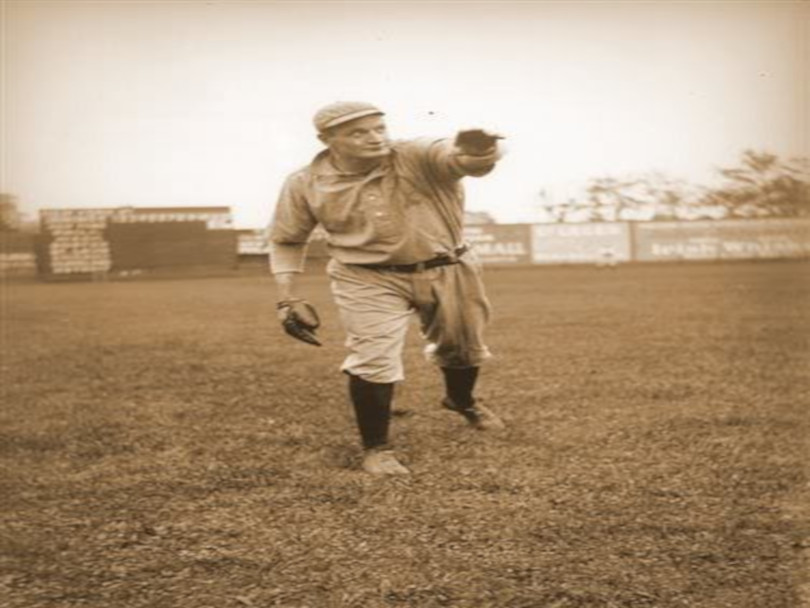
Ty Cobb
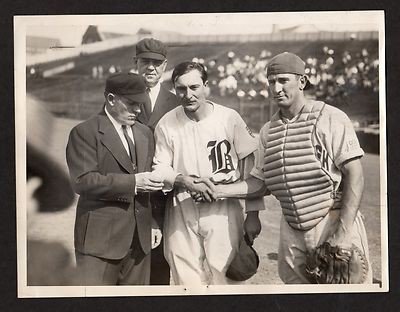
In 24 seasons, mostly with the Detroit Tigers, Ty Cobb compiled a .367 batting average, the highest in the history of the game. He was the all-time leader in runs scored for more than 70 years, and in hits for nearly 60 years. In 1936, Cobb became the first man inducted into the Hall of Fame, earning 222 out of a possible 226 votes, more than Babe Ruth, Nap Lajoie, Walter Johnson, or Honus Wagner. Cobb blazed and battled a path through baseball, retiring with more records than any other player. He was raised by a demanding father who named his son after the Lebanon city of Tyre, which showed tremendous courage in repelling the armies of Alexander the Great. |
Full bio ⇓
Quotes About Cobb
"He did everything except steal first base. And I think he even did that in the dead of night." — Rube Bressler
"He played as if he had brains in his feet." — Branch Rickey
"Every time at-bat for him was a crusade, and that’s why he’s off in a circle by himself." — Charlie Gehringer
Quotes From Cobb
"I find little comfort in the popular Cobb as a spike-slashing demon of the diamond with a wide streak of cruelty in his nature. The fights and feuds I was in have been steadily slanted to put me in the wrong."
"Baseball is a red-blooded sport for red-blooded men….a struggle for supremacy, survival of the fittest."
Played For
Detroit Tigers (1905-1926)
Philadelphia Athletics (1927-1928)
Managed
Detroit Tigers (1921-1926)
Minor League Experience
1904-1905: Augusta Tourists (South Atlantic League)
1904: Anniston (Alabama-Texas-Louisiana League)
All-Time Rankings
Ty Cobb ranks #2 among the Top 50 all-time at CF. Rankings ⇒
Best Season: 1911
Cobb's finest efforts came in his seventh season. That year, he set career highs in runs (147), hits (248), doubles (47), triples (24), RBI (127), average (.420) and slugging percentage (.621). He led the AL in each category, as he also did with 83 stolen bases. He missed the Triple Crown by three homers as Frank "Home Run" Baker led with 11. He also set a then AL record with a 40-game hitting streak which helped him edge Shoeless Joe Jackson for the batting title. Over the course of the season Cobb struck out swinging just two times. The numbers overshadowed Cobb's combative personality and won him the first ever MVP, then called the Chalmers Award.
Factoids
Ty Cobb became the first ball player to star in a movie, a drama written by Grantland Rice called Somewhere in Georgia.
Playing in Detroit, the growing "Motor City" most of his career, Ty Cobb enjoyed fine cars. He even raced automobiles in the early 1910s, before he was asked to halt the dangerous practice by Tigers ownership.
One of Ty Cobb's best friends was the president of Coca-Cola Robert Woodruff, a fellow Georgian and avid hunter.
Full Bio
The eldest of three children, Tyrus Raymond Cobb grew up in Royston, Georgia, under the watchful eyes of his father, William; a schoolteacher, principal, newspaper publisher, state senator, and county school commissioner who urged Ty to study. When Ty went off to play professional baseball, his father sternly warned him "Don't come home a failure."
Cobb intended to become a physician or a prominent politician in Georgia but decided to pursue baseball when his athletic ability blossomed as a teenager. By 1905, the 18-year-old was a rookie outfielder for the Detroit Tigers. Two years later he won the American League batting title, the first of 12 he would capture.
It is unlikely that anyone can beat his lifetime batting average. In his 24 seasons he topped the .300 barrier 23 times. Cobb's first great season came in 1907, and the Tigers rode that success all the way to the World Series. That season the outfielder's batting average was .350 - the best in the AL. Other league bests included 212 hits, 119 RBI's, and 49 stolen bases. Cobb did not stop there. He won nine consecutive batting titles starting in 1907.
Cobb might be remembered best for his intimidating playing style. He was never afraid to go to extremes to win a game. He could take pain, as well as hand it out. "I recall when Cobb played a series with each leg a mass of raw flesh," Grantland Rice wrote. "He had a temperature of 103 and the doctors ordered him to bed for several days, but he got three hits, stole three bases, and won the game. Afterward he collapsed at the bench."
Cobb looked for every possible way to win. He used his great speed and precision hitting as the best weapons available in the dead-ball, strong-pitching era. Cobb studied pitchers and took advantage of their weaknesses. Against Walter Johnson, the great Washington right-hander who was afraid of hitting batters with fastballs, Cobb crowded the plate. Johnson worked him outside, fell behind in the count, and finally threw hittable pitches over the plate. Cobb clobbered ball after ball.
Cobb paid the price for success. He would practice sliding until his legs were raw. He would place blankets along the baseline, and he practiced bunting a ball into a basket. During the winter he hunted through daylight hours in weighted boots so that his legs would be strong for the upcoming campaign. He never failed to capitalize on an opportunity to gain an edge over his opponents, most of whom admired his drive to succeed.
Cobb engaged in annual haggles with Detroit executives before signing his contract, and those earnings were invested wisely, mostly in General Motors and Coca-Cola stock, which made him baseball's first millionaire.
Cobb's late career was marred by a gambling episode that involved Tris Speaker, one of his few friends in baseball. Commissioner Kenesaw Mountain Landis helped conceal the details of the scandal to ensure the two great ballplayers would not tarnish their image nor that of the game.
Known for his combative personality, it was that tempestuous attitude that gave Cobb his edge and helped him achieve excellence. He was shrewd and methodical, careful to learn the weakness of every opponent. As a baserunner he was unmatched in daring and skill, leading the league in steals six times. When the game changed in the 1920s and the home run became vogue, Cobb steadfastly stuck to "inside baseball" - bunting, running and slashing his way to more than 4,000 career hits.
Description
Cobb was a large man for his era, standing over 6-feet, one-inch tall and weighing around 190 pounds in his prime. He had light hair, which at times was described as blonde or even a light shade of orange. In his later years his hair receded. He had intense eyes and a toothy grin, which he flashed readily but never on the diamond. He was descibed as handsome and was very popular with female fans in Detroit and in his native Georgia.
Scouting Report
There wasn't a way to get Cobb out consistently. However, if we look at the numbers, the pitchers who gave Cobb the most trouble were junkballers with peculiar or deceptive deliveries. It's probably true to say that when pitchers faced Ty Cobb when the spitter was still legal, they put more goop on the ball, dirtier the ball with more licorice and tobacco, and resorted to the goofiest deliveries they could muster.
Where He Played
OF (2,934 games), 1B (14), pitcher (3), 2B (2), 3B (1). Cobb was primarily a center fielder, with the notable exception of the Tigers pennant years of 1907-1909.
As a Manager
Cobb accepted the job as Tiger manager reluctantly in 1921. His friend, Tris Speaker, had just guided the Indians to a World Series title as player/manager, and Cobb thought he could accomplish the same. However, he never desired the added attention, nor the aggrivation of dealing with his players (especially pitchers) nor the front office. He gained a reputation as an excellent batting coach, which was deserved. He helped transform Fred Haney and Lu Blue, as well as Heinie Manush, Harry Heilmann, and Bob Fothergill, into excellent big league hitters.
Born
Tyrus Raymond Cobb was born on December 18, 1886, in The Narrows, GA.
Died
July 17, 1961, Atlanta, GA
Batted: Left
Threw: Right
Primary Position: OF
Primary Team: DET
Major League Debut
August 30, 1905 ... Cobb had never been above the Mason-Dixon Line, and now he was on his way to a city larger than any he had ever seen. After a few missed connections, Cobb arrived in Detroit by train on August 29, and checked in to a hotel within walking distance of Bennett Park. Detroit’s Bennett Park was located on the corner of Michigan and Trumbull in the heart of the city in a section called “Corktown,” because of the predominance of Irish immigrants living there. Cobb reported to the park on August 30, just over three weeks after the death of his father. He was ready to start his big league career. The Detroit Free Press, writing of his arrival and his minor league batting success, speculated that the young Georgian “wouldn’t pile up anything like that in this league.”
Cobb saw action immediately with the Tigers, who were hosting the New York Highlanders in the second of a three-game series. Bennett Park was named for Charlie Bennett, a star for the National League’s Detroit Wolverines in the 1880s. A catcher, Bennett’s career was ended abruptly when he lost both of his legs in a terrible train accident in 1894. Bennett had been tremendously popular in Detroit, and in 1900, when the city earned a team in the Western League (later to become the American League), their ballpark was named in his honor.
The Highlanders, later to be known as the Yankees, started ace “Happy Jack” Chesbro, a master of the spitball. The previous season, Chesbro had won an amazing 41 games and pitched more than 400 innings for the New York club. The Tigers, managed by Bill Armour, countered with “Big George” Mullin, a fidgety right-hander from Wabash, Indiana. In front of an afternoon crowd of approximately 1,200 fans, Cobb hit fifth in the lineup, playing center field. Armour’s Tigers, due to injury, had a shortage in the outfield. In the bottom of the first inning, the Tigers hit Chesbro hard, putting together a double, single, and a sacrifice bunt to plate one run and move another runner to third. With one out, the left-handed hitting Cobb strolled to the plate for his first major league at-bat. Using the hands-apart grip that he’d perfected as a boy in Georgia, 18-year old Ty Cobb peered out at Jack Chesbro and tried to overcome the nerves that were causing his stomach to twist and turn. The first pitch he saw was a high fastball that he swung through and missed. The next offering from Chesbro was a spitter that fooled Cobb for strike two. Chesbro then returned to his fastball, sending a pitch into the heart of the strike zone that Cobb met with a flick of his bat. The ball soared into the left-center field gap where it was retrieved by New York left fielder Noodles Hahn, whose throw to second base was a split second too late to catch the sliding Georgian. “Pinky” Lindsay, the Tigers’ runner on third, trotted home to make the score 2-0. Ty Cobb had his first hit, first run batted in, and first double in the big leagues, having victimized one of the best pitchers in the league. Ty walked against Chesbro his next time up, and with Sam Crawford in front of him on second base, Cobb was out on the backend of a double steal attempt, but it did little to dampen the day for the Tigers, as they vanquished the Highlanders, 5-3. In center field, Cobb handled two putouts without incident and his first big league game was under his belt.
— from Ty Cobb, by Dan Holmes
Nine Other Players Who Debuted in 1905
Ty Cobb
Hal Chase
Mickey Doolan
Otto Knabe
Al Bridwell
Rube Oldring
Eddie Cicotte
Ed Reulbach
George Gibson
Nicknames
The Georgia Peach
Cobb's friends could call him simply "Peach." And yes, he had friends.
Uniform Numbers
There were no uniform numbers in Cobb's era. When the Tigers played their final game at the corner of Michigan and Trumball in 1999, every starter wore the uniform number of a Detroit legend. Center fielder Gabe Kapler wore a jersey without a number, in honor of Cobb. That jersey is in the Hall of Fame.
Family Tree
Ty had great hopes for his son, Ty Jr., but the boy was a disappointment as an athlete. Never wanting to draw comparisons to his famous father, and lacking the skill to play the game, Ty Jr. never warmed to baseball. In college, he irritated his father when he went out for the tennis team.
Similar Players
None truly comparable, though Tris Speaker had some of the same characteristics as an offensive player.
Related Players
Matty McIntyre, Honus Wagner, Nap Lajoie, Sam Crawford, Walter Johnson, Joe Jackson, Babe Ruth, Harry Heilmann, Heinie Manush, Tris Speaker, Joe Wood, Dutch Leonard, Charlie Gehringer, Pete Rose, Lou Brock, Rickey Henderson
| Hall of Fame Voting |
| Year |
Election |
Votes |
Pct |
| 1936 |
BBWAA |
222 |
98.2% |
|
Post-Season Appearances
1907 World Series
1908 World Series
1909 World Series
The Pitches He Threw
Cobb actually toed the rubber three times in his career, He did it twice in 1918 at the tail-end of the season, when he thought he may never play again (he was off to serve in the war). Later, as player/manager, Cobb inserted himself in relief. He set down all three baters he faced. For his career, Cobb had a 3.60 ERA in five innings, with no strikeouts and two walks. Like most positionplayers, he thought he could pitch, if he had concentrated his efforts on it. A part of Cobb probably wanted to pitch to see if he could do the things Ruth had done as a pitcher/batter.
Post-Season Notes
The story goes that when Cobb reached base for the frist time in the 1909 World Series, he yelled down to Pirates shortstop Honus Wagner, "I'm comin' down on the next pitch, krauthead!" Which he did.
When he slid in with dust flying, Wagner slapped the tag on Cobb, some say woth a little extra force, and growled at the Tiger star: "Get back in your cage, animal."
Awards and Honors
1909 AL Triple Crown
1911 AL MVP
Feats
Six times in his career, Cobb reached base and proceeded to steal second, third and home. The first time he did it was in 1907, the final time was in 1924... On May 5, 1925, Cobb blasted three homers, a double and two singles in one game, for a then-record 16 total bases. The next day he hit two more homers.
Milestones
Collected his 3,000th hit on August 19, 1921; his 4,000th hit on July 19, 1927, against the Tigers, as a mamber of the Philadelphia A's.
Milestones
- August 19, 1921: 3000th Hit... Collected his 3,000th hit off Elmer Myers… Hit was a single… Came in the second game of doubleheader.
- July 18, 1927: 4000th Hit...
Batting Feats
- September 2, 1907: Steal 2nd, 3rd, Home...
- July 23, 1909: Steal 2nd, 3rd, Home...
- July 12, 1911: Steal 2nd, 3rd, Home...
- July 4, 1912: Steal 2nd, 3rd, Home...
- June 18, 1917: Steal 2nd, 3rd, Home...
- August 10, 1924: Steal 2nd, 3rd, Home...
- May 5, 1925: 16 Total Bases...
- May 5, 1925: 6 Hits...
Notes
It's well chronicled that Cobb never won a World Series, though he played in three Fall Classics, all as a young man, prior to his peak as a player. His teams were competitive however: in his 19 seasons as a regular, the teams he played on were 1542-1331, a .537 winning percentage... No player in baseball history drove in more teammates than did Cobb. When you subtract home runs from RBI, you have the number of teammates batted in (TBI), Cobb leads all-time with 1,843.
Injuries and Explanation for Missed Playing Time
In June of 1920, just as he was getting hot with the bat, Cobb suffered the worst injury of his playing career. As he chased a fly ball in right-center in Chicago’s Comiskey Park, he collided with Flagstead and fell to the ground in pain. He had wrenched his left knee, tearing ligaments. After consulting a specialist in Chicago, Cobb was sent home to Augusta to recuperate. He was out of the lineup for more than a month, not returning until July 8, when he delivered a dramatic ninth inning game-tying single against the Yankees. With Bobby Veach on third representing the winning run, he and Cobb attempted a double steal. Despite his still-aching knee, Cobb hustled safely into second base as Veach scored on a bad throw to give the Tigers the victory. Two days later, Cobb was back in the lineup for good, starting a 20-game hitting streak in which he batted .471.
Hitting Streaks
40 games (1911)
35 games (1917)
25 games (1906)
21 games (1926)
21 games (1927)
Transactions
After the gambling scandal that nearly ruined Cobb's reputation, Ty was asked to leave the Detroit Tigers as player /manager following the '26 season. He successfully fought to clear his name, and then retired to his home in Augusta, Georgia. But in February, Connie Mack made a much-publicized visit to Cobb and convinced the veteran to play one more season with his Philadelphia A's. Cobb signed for $40,000 with the option for a $30,000 bonus should the A's attendance rise above a certain level. Cobb was attracted by the prospect of proving himself after the gambling accusations. He also liked the notion of playing on a winning ball club.
Home Run Facts
Navin Field was not particularly easy to homer in during Cobb's day. He hit 111 homers as a Tiger, with 79 (71%) coming on the road. The park had that deep center field and the gaps were also cavernous. It was short down the line, but Cobb didn't pull the ball as much as power hitters today would. 46 of Cobb's 117 career home runs were inside-the-park.
Hall of Fame Artifacts
Sliding pants, which he wore under his uniform to protect his legs; baseball bats, signed baseball, his glove, spikes, wool Detroit Tigers sweater (circa 1918), dentures, and his diary, among other things.
Matchup Data
Ty Cobb batted .366 against the best pitcher in baseball, Walter Johnson.
Trivia Question
After his rookie season, who was the only player to pinch-hit for Ty Cobb?
Trivia Answer
Jimmy Dykes in 1928.
Replaced
Matty McIntyre, who didn't welcome the challenge to his job.
Replaced By
Bing Miller, who had actually been around a while, but lost his starting job when Mack signed Cobb and Speaker in 1927-1928. Miller was a fine player, batting .311 for his career.
Best Strength as a Player
Baserunning and batting eye.
Largest Weakness as a Player
Cobb had no weakness on a ball field.
Learn More about Ty Cobb
Ty Cobb Museum
Other stories on the Web about Ty Cobb
Ty Cobb: Genius in Spikes ⇒
Learn More about Ty Cobb
Search Amazon.com for Books about Ty Cobb ⇒
Search for Ty Cobb at Google ⇒
View a map of his hometown at Mapquest ⇒
Sources used for the Ty Cobb Player Page:
Ty Cobb: A Biography, by Dan Holmes; The Tiger Wore Spikes, by John McCallum; Interviews with Richard Bak and Marc Okkonen, Ty Cobb, by Charles Alexander.