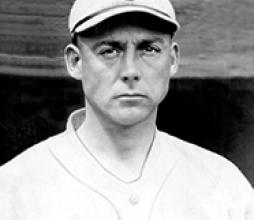
Joe Dobson
- Position(s):
- P
- Nicknames:
- Burrhead
- Born:
- January 20, 1917
- Bats:
- Right
- Throws:
- Right
- Height:
- 6' 2"
- Weight:
- 197 lbs
- Major League Debut:
- 4-26-1939 with CLE
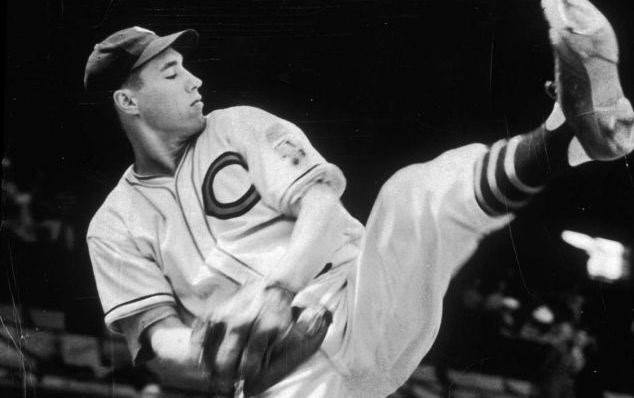
In the early years of the 21st century, the name of Joe Dobson, a right-handed pitcher who toiled for 10 years with the Red Sox, rarely crops up in discussions of the better Boston players of the past. Nonetheless, his 106-72 record places him ninth on the all-time team list for wins and his .596 winning percentage has him in 13th place among those with 100 or more decisions. Leigh Grossman succinctly summarized his career: “never a great pitcher, but he was good and consistent for a long time.” The only category Dobson ever led his league in was wild pitches, but he was a key component in the pennant-winning year of 1946 and no Red Sox pitcher surpassed him over the following four years when Boston was regularly in contention.
Dobson was a big pitcher for the day, 6’2” tall, with a playing weight of 200 pounds and a shock of wavy hair that earned him the nicknames “Burrhead” and “Curly.” Joe hailed from Oklahoma, born in the south-central farm town of Durant on January 20, 1917, a little more than nine years after Oklahoma became the country’s 46th state. The youngest of 14 children born to William and Lura Dobson, he moved with his family to Coolidge, Arizona, when Joe was 6 years old. William Dobson was a farmer who turned to carpentry in his later years. Midway between Phoenix and Tucson, it was in Coolidge that Joe was raised and where at age 9 or 10 he lost his left thumb and part of his forefinger in a childhood accident while inexpertly trying to blow up a rock with a dynamite cap a friend had found.
One of Joe’s brothers was a pretty good ballplayer, he recalled. “We’d play catch every day. He’d throw that ball so hard, my hands would hurt.”1 It was during his sophomore year in high school that he began to play baseball. “Before that time I had been content to do all my pitching at prairie dogs and such, just to improve my marksmanship and save money on ammunition.” He was helping his dad with carpentry outside of school when he read in the town newspaper that a Dr. Tremble was organizing a team in Tucson and looking for boys who would like to play baseball. He tried out and was added to the team. The first game he pitched, he beat Tombstone. The ballclub came together well and some of the businessmen put some money behind it, naming the team the Tucson Merchants. When Joe won the first game of a doubleheader during the July 1936 Arizona state tournament in Phoenix, he was approached by a Cleveland Indians scout, Grover Land, who asked Joe if he wanted to play pro ball. Joe’s feelings at the time reflect those of many: “I would have paid him to sign me up.” The Tucson team went on to Wichita for the national semipro tournament and Joe won a couple of games in the semifinals, but they couldn’t win it all. Land, though, landed Dobson and signed him to a contract with New Orleans, an Indians farm club in the Southern Association.
His first year in the Cleveland system was spent in Alabama with the Troy (Alabama) Trojans in the Alabama-Florida League under manager Charles Moss. Troy finished second in the six-team Class D league, while Joe posted a record of 19-12 with a 2.27 ERA, leading the league in complete games with 26. He struck out an even 200 batters, walking only 71. His work earned him a quick promotion all the way to the Class A Southern Association, where he pitched in 1938 for Larry Gilbert and the New Orleans Pelicans. At this elevated level, Dobson was 11-7 (3.29) in 178 innings of work. He made it to the major leagues to stay in 1939, beginning a career that took him right into the 1954 season.
Dobson was hardly a sensation in Cleveland, though. Things started well enough when he was called in to relieve on April 26 after Johnny Broaca had given up four runs to the White Sox in the third inning. Joe gave up three hits and no runs in five innings of work. Manager Ossie Vitt gave him a start four days later in Detroit. He pitched five innings in that game, too, but that didn’t go as well: Dobson was tagged for nine runs on 13 hits and lost the 14-1 ballgame. Joe appeared in 35 games, but largely in relief. He had just two more starts, one in June and one in August, and in those, too, the opposition scored into double digits, but the June loss was fully attributable to reliever Johnny Humphries. Dobson threw 78 innings and wound up with a 2-3 record and a 5.88 earned run average.
He pitched an even 100 innings in 1940, and showed some improvement. He ended the season 3-7, appearing in 40 games and recording an ERA of 4.95. The first game he started and won came against the Red Sox on July 21 at Fenway Park. He threw a complete-game, 2-0 shutout, allowing seven hits and walking three, inducing batters to hit into three double plays. Dobson’s work that day made an impression on Boston manager Joe Cronin. A few outings earned him recognition in the press, such as a one-hit, 5 1/3-inning stint on September 1 termed “brilliant relief pitching” by the Associated Press. Even though Vitt used him often, he felt overlooked. He realized he was, as he put it to Boston sports scribe Johnny Drohan, “just a ball player named Joe …. I couldn’t have been any more forgotten had I been a brother to King Tut. I did get in a few ball games but only after all the other pitchers on the bench had been knocked out of there.”2
A December 12 trade reported at the time as a three-cornered deal brought the pitcher named Joe to Boston. The Red Sox sent Doc Cramer to the Senators for Gee Walker, then traded Jim Bagby, Gene Desautels, and Walker to Cleveland and got Dobson, Odell Hale, and Frankie Pytlak. Dobson was happy to land in Boston. “Joe Cronin probably appreciated me more than the entire Cleveland organization,” he told Drohan.
With Bob Feller, Mel Harder, Johnny Allen, and Al Milnar in the rotation, it had been hard to break in as a starter with the Indians, but Dobson had a shot with the 1941 Red Sox as Lefty Grove’s career wound down, joining a Boston team with Dick Newsome, Mickey Harris, and Charlie Wagner among the other starters. Dobson showed “hustle and determination and stuff” in spring training in Sarasota.3 Ed Rumill of the Christian Science Monitor predicted early in spring training that “he may turn out to be one of the surprises of the…campaign.”4 For the 1941 season, Newsome won 19, and Wagner and Dobson were second with a dozen wins apiece. Joe didn’t last long in his first start, on May 23, but the Yankee Stadium game ended in a 9-9 tie due to darkness. Six days later, he started and won a game against Philadelphia. It had taken him a while to get established, but he became a regular in the rotation and at one point reeled off a string of eight straight victories -- something always sure to impress. That winter he could look back at a 12-5 season, with an improved 4.49 ERA, and know that he’d helped the Red Sox to a second-place finish.
Joe credited Frankie Pytlak and Jimmie Foxx with helping turn him around. Joe was 5-5 in mid-August and still struggling with his location when Pytlak told him one day, “Relax, don’t try to throw so hard and try to pick your spots around the plate.” On another occasion, Foxx said, “Take it easy, Joe. Let up a little. You don’t have to strike out every hitter.”5 Nothing special by way of advice, perhaps, but coming from Foxx and coming in a time when coaches rarely gave much real instruction to pitchers, it may have made the difference. Equally important may have been Ted Williams, who had hurt his foot and wanted to take some extra batting practice to help him come back. He asked Joe to throw to him and in the one-on-one pitching repeatedly to a .400 hitter, Joe may have become better able to harness He said he was looking forward to spending time at home. His wife was feeling poorly, and he was tired of traveling.
The Red Sox offered Joe a last hurrah in 1954, announcing Dobson’s signing of a free agent contract on January 13. “He’s still got some good pitches in his strong right arm,” declared GM Joe Cronin. “We expect him to win some games for us and also help teach and guide some of the young pitchers we’ll have on our staff.” Manager Lou Boudreau added, “I can’t believe that Dobson is all through. He’s always taken good care of himself.” Joe didn’t really have enough left. He got into two games, long enough to record eight outs but gave up five hits and two runs and a walk -- and one final strikeout, finishing his career just shy of 1,000 with 992 K’s. The Red Sox released him on May 8, offering him a coaching contract at the same time. He thought it over for a couple of days and agreed, but then resigned a little over seven weeks later, in early July. He’d worked largely as a “special observer” sitting in the stands and taking notes.
Joe decided to leave baseball -- though he was enticed once more to coach for the White Sox in 1955. By October, he was living in Munsonville, New Hampshire (population 231), and spending 12 hours a day, seven days a week operating Joe Dobson’s Store, a village general store about 10 miles north of Keene. The store also rented cabins and boats, sold gas, and Joe served as the town’s postmaster and head of the volunteer fire department. He termed it a “change of pace.” He truly enjoyed the work, living there with Maxine and an infant daughter, Pam. His 17-year-old son from his first marriage, Joe Junior, was raised elsewhere. It wasn’t easy. “Ballplayers don’t know what hard work really is,” he said. Every day you pitched extra innings, with nobody backing you up in the bullpen.16 Pam recalls baseballs and bats hanging from the store’s ceiling for a little extra decorative flavor.
By 1967, as the Red Sox embarked upon their Impossible Dream season, Joe was the manager and golf pro at the Kearsage Valley Country Club in North Sutton, New Hampshire. The year before, Ted Williams and Dom DiMaggio had earned the club some extra publicity, appearing at a benefit there. Joe had run the course at Laconia before that. He worked at Kearsage for seven years and then in February 1972 moved to Winter Haven, Florida, where he became general manager of the Red Sox complex there and business manager of the Winter Haven Red Sox through 1978.
His wife Maxine passed away in 1976. He later married Dorothy Veness, who survived his passing. After retiring from his work for the Red Sox, Joe and his family moved to his sister’s ranch outside Tombstone where he helped with ranch work, fixing fence posts and looking over a herd of 40-50 cattle. In the late 1980s, he moved to Jacksonville and truly retired. It was in Jacksonville that he died of cancer at the age of 77 on June 23, 1994.
Note
This biography originally appeared in the book Spahn, Sain, and Teddy Ballgame: Boston's (almost) Perfect Baseball Summer of 1948, edited by Bill Nowlin and published by Rounder Books in 2008.
Notes
1. Lautier, Jack. Fenway Voices, p. 46
2. Boston Traveler, June 4, 1941
3. The Sporting News, March 20, 1941
4. Christian Science Monitor, March 4, 1941
5. Christian Science Monitor, March 4, 1942, and The Sporting News, January 15, 1942
6. Hartford Courant, March 17, 1942
7. Golenbock, Peter. Red Sox Nation, p. 135
8. The “kinky-haired” descriptor is from a 1942 Sporting News story; the glove is detailed in a March 31, 1941, Christian Science Monitor story.
9. E-mail communication from Christopher Williams, January 25, 2008
10. Christian Science Monitor, November 17, 1945
11. E-mail communication from Gary Bedingfield, January 25, 2008
12. The Sporting News, October 16, 1946
13. Stevens, Howell. The Sporting News, February 26, 1947
14. Chicago Tribune, July 28, 1953
15. Christian Science Monitor, August 28, 1953]
16. Nason, Jerry. The Sporting News, October 19, 1955
Sources
Interview with Pam Dobson Garcia on February 6, 2008.
Thanks to Gary Bedingfield and Christopher Williams.
www.retrosheet.com
Photo Credit
The Topps Company
Related Content
May 26
-
1995
On May 26, 1995, Ken Griffey Jr. of the Seattle Mariners bre ...
-
1993
On May 26, 1993, a fly ball by Cleveland’s Carlos Martinez ...
-
1969
On May 26, 1969, Hank Aaron hits his 500th career double, be ...
Sponsored Links
- Tagged:
- 1946 World Series, Boston Red Sox, Joe Dobson, Pitcher

Comments
Be respectful, keep it clean.