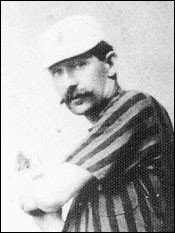
Doc Prothro
- Position(s):
- 3B, SS
- Born:
- July 16, 1893
- Bats:
- Right
- Throws:
- Right
- Height:
- 5' 10"
- Weight:
- 170 lbs
- Major League Debut:
- 9-26-1920 with WS1
Doc Prothro never played professional baseball until he was 26 years
old. He was a dentist with his own practice in Dyersburg, Tennessee
pitching for a town team when he was spotted by a scout and signed,
skipping the minor leagues and heading straight to a major-league debut
in Washington DC. He spent over a dozen years in organized ball, managed
in the minor leagues and then as manager of the Philadelphia Phillies
from 1939 through 1941.
James Thompson Prothro was born in Memphis on July 16, 1893, the oldest
child of John and Roberta Prothro. John was a clerk, who by 1920 had
progressed to become chief clerk in the U. S. Engineers Office. The
Prothros had three daughters: Mary, Roberta, and Marie Evelyn.
James enrolled as a student at Castle Heights Military Academy in
Lebanon, Tennessee, east of Nashville. There he played football and
basketball and competed in track. After graduation, he entered the
University of Tennessee’s College of Dentistry at Memphis, only taking
out time to serve during the world war in the Dental Corps. He married
on October 3, 1917, to a “comely, slender lady of the South,” Katherine
Cates. [Unattributed January 10, 1941, clipping in Prothro’s player file
at the Hall of Fame] He was known among ballplayers as “Doc” but to
Katherine he was “Thompson.” The couple had one child, James Jr., known
as Tommy. Tommy Prothro became a star football player at Duke, then a
highly successful coach at Oregon State and UCLA, and the Los Angeles
Rams and San Diego Chargers. Katherine’s brother Clifton Cates served as
Commandant of the United States Marine Corps from 1948 to1954.
Our subject, Doc Prothro, was a right-handed third baseman throughout
almost his entire career, only very rarely filling in at shortstop. But
it truly was in dentistry that he began, setting up a practice after
graduation from dental school for two years in Memphis and then one in
Dyersburg, Tennessee – a little over 75 miles northeast from Memphis. He
played shortstop on Dyersburg’s semipro town team in 1919 and 1920 and
as it happened scout Joe Engel of the Washington Senators umpired a
number of the games and was impressed with Prothro’s play. He wired
Senators owner Clark Griffith, who authorized a generous $500 per month
“and assured me that I’d be made a free agent if I didn’t like where
they sent me,” Prothro said. [The Sporting News obituary]
He went directly to join the Senators and enjoyed his major-league debut
on September 26, 1920, at the Polo Grounds in New York. He pinch-hit
for pitcher Joe Gleason in the top of the ninth and singled in one of
the three runs in a rally that fell short, as the Yankees won the game,
9-5. He appeared in five other games right at the end of the year,
singling five times in 13 at-bats (.385). He whiffed four times, too.
When the Senators assigned him to Reading in 1921, he took up Griffith’s
offer and refused to report.
It was back to Dyersburg and dentistry and town team ball for 1921 and
1922. In 1923, he applied for reinstatement with the Senators, and a
somewhat astonishing series of transactions followed. By prearrangement,
his application was accepted and he was reinstated but immediately sold
to the Memphis Chickasaws (Southern Association), a Class A team not
coincidentally right in his hometown. Doc played in 111 games for the
Chicks, batting .296 with a slugging percentage of .390. He was
repurchased by Washington at the end of the Southern Association season
and again appeared in six late-season games, this time hitting .250. The
following year he opened the season with the Senators and played
through June 20 (hitting an excellent .333 in 159 at-bats) but was
traded back to Memphis on June 28 (along with Carr Smith) for
third-baseman Tommy Taylor. He appeared in 76 games for the Chicks,
batting .325 but followed the 1924 World Series from afar. The Senators
were world champions, but Prothro was back in Tennessee seeing dental
patients as he did in the offseason.
After the Series, the Senators repurchased his contract, but then traded
him to the Boston Red Sox on December 11, for infielder Mike McNally –
who’d become Boston property just the day before in a deal with the
Yanks who traded him for Howie Shanks. New York had wanted to get Shanks
and returned McNally to Boston (the Red Sox had traded him to New York
back in 1920.)
Doc Prothro spent just one year with the Red Sox, but it was a good
year. The third baseman batted .313 with 51 RBIs in 415 at-bats. This
was a dreadful Red Sox team; in fact, Doc’s .313 batting average was
higher than the team’s .309 winning percentage. He appeared in 119 of
those games, and his 52 walks helped him post a .390 on-base percentage.
It was his only full year in major-league ball. He was involved in a
three-way deal which sent Bill Wambsganss to the Athletics, sent Prothro
to the Portland Beavers, and brought Emmett McCann to the Red Sox. [Washington Post,
December 11, 1925] McCann hardly played, appearing in only six games.
The Red Sox replaced with the weak-hitting Fred Haney, who led the
league in errors, too.
The next year (1926) Prothro was gone, to Portland, Oregon where he
played with the Beavers in the Pacific Coast League. He hit well again,
.327 in 130 games (with 14 homers) and was sent to the Cincinnati Reds
in time to get into three late-season games and add one more hit, a
triple, and one more run batted in to his major-league resume. That was
his last major-league hurrah as a ballplayer. He was sent back to
Portland after the season and played there again in 1927, hitting .330
with 10 home runs.
At this point, late in 1927 the Chicago Cubs drafted him. He had been
discussing an offer to become a playing manager for the Memphis Chicks
when the Cubs unexpectedly drafted him. Prothro traveled to Chicago to
confer with Cubs owner Bill Veeck, who consented to sell his contract to
Memphis on the condition that he was indeed made the manager. He took
over the Chicks from Clyde Milan and the team began a turnaround. They’d
been a middling club in the Southern Association standings, but he
managed the Chicks for seven seasons, playing in each of them, though
not frequently after the first three (1928-1930). In 1928, the Chicks
finished in second place, just a half-game behind the Birmingham Barons.
In 1929, they slipped to fourth but in 1930 won the flag, as they did
in 1932 and 1933. His last year with Memphis was 1934, and his playing
career ended with a lifetime .312 average in 4,009 at-bats, slightly
below the .318 career mark in the majors.
After Tom Yawkey bought the Red Sox, he poured money into building
Boston a stronger farm system and hired Prothro away to manage the
Little Rock Travelers starting in 1935, where he reportedly did quite a
good job developing young prospects – and won the Southern Association
pennant and playoffs in 1937. One of the prospects who passed through
Little Rock was Johnny Sain, who told Baseball Digest that after
he was given a workout with the club, Doc signed him and placed him in
his first professional engagement with Osceola of the Class D Northeast
Arkansas League. [Baseball Digest, November 1946] The Travelers
faded in 1938, but Doc moved up in the world, accepting a two-year
contract to manage in the National League. From 1939 through 1941, he
managed the Philadelphia Phillies. It looked like a job where he
couldn’t help but come out looking good; his predecessor, Jimmie Wilson,
was coming off a 45-105 last-place finish.
It wasn’t going to be an easy task, he said during spring training in
New Braunfels, Texas. The Associated Press said he’d found four faults
with the Phillies: “too much dead wood, no spark, over-abundance of
hams, and ingrown resignation to losing.” He griped, “A team can show
some hustle, some fight, no matter how bad it’s being licked.” [New York World-Telegram,
March 14, 1939] Comments he made indicate he was realistic but
optimistic he could make some progress. Just as the 1939 got underway,
he admitted, “I’ve got to figure my team is the weaker every time it
goes into action, and so my scheme is to maneuver it into the one spot
that might develop a game-winning situation.” [Unattributed April 26,
1939, clipping in Prothro’s Hall of Fame player file]
Nothing improved, though, and Prothro’s ’39 Phillies won the same 45
games, but lost one more (45-106). In 1940, they won 50 games, but in
1941, it was only 43. All three years, the Phillies finished last, and
never closer than 50 games behind the league leader. After three
straight last-place finishes, Phillies owner Gerry Nugent sold the team
and Prothro returned back home to Memphis. “I worked for one of the
finest men who ever lived,” he said, speaking of Nugent. “But the teams
we had were horrible. Every time we came up with a good player we had to
sell him in order to stay in business. It was a nightmare.” [Prothro
obituary in The Sporting News]
Back in Memphis, he took an ownership interest in the Chicks, and served
as manager from 1942 through 1947, retiring after the 1947 season and
selling his interest in the team to the Chicago White Sox that December.
In the 1930s, Prothro had maintained his residence in Memphis but also
purchased a 616-acre farm across the Mississippi River in Arkansas.
There was even a station there named “Prothro” on the schedule of the
Missouri Pacific Railroad.
He died on October 14, 1971, in Memphis after a long illness. His widow, son, and all three sisters survived him.
Sources
In addition to the sources cited above, the author relied upon the
online SABR Encyclopedia, retrosheet.org, and Baseball-Reference.com.
Thanks to Rod Nelson.This biography can also be found on SABR bioproject.
Related Content
May 28
-
1978
On May 28, 1978, future Hall of Famer Jim Palmer records the ...
-
1973
On May 28, 1973, Chicago White Sox hurler Wilbur Wood picks ...
-
1968
On May 28, 1968, the American League announces that it will ...
Sponsored Links
- Tagged:
- Doc Prothro

Comments
Be respectful, keep it clean.