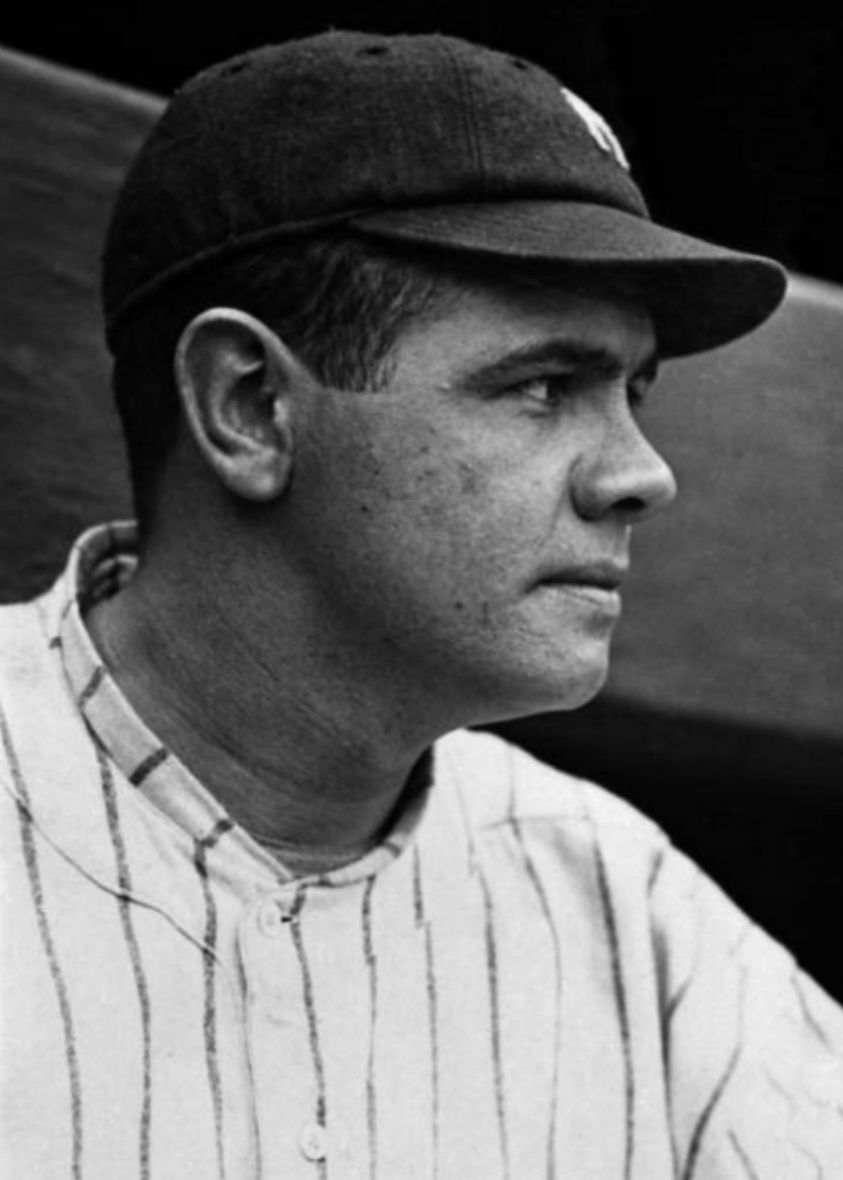
Babe Ruth
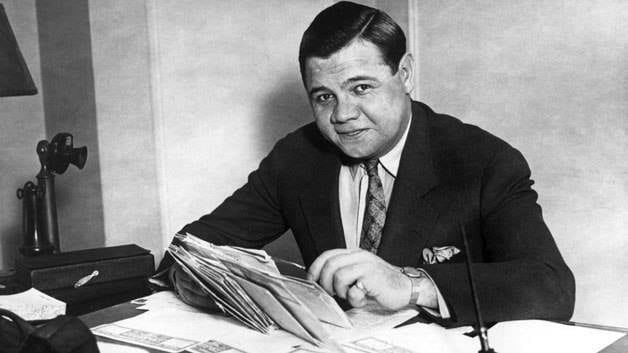
In a time when baseball, reeling from the 1919 Black Sox scandal, declining attendance and declining credibility, needed a revitalization, Babe Ruth's bat saved the day. The most vibrant, dominant, and popular athlete in American history, the Babe turned baseball on its head, sparking fan interest and excitement, and the birth of the most enduring dynasty in sports history. The Roaring Twenties were epitomized by the Yankee slugger. He retired as baseball's all-time leader in home runs, runs batted in, and walks, and his name has come to signify greatness and largesse. He was the prototypical American hero. |
Full bio ⇓
| Career Batting Stats |
| G |
AB |
H |
R |
HR |
RBI |
SB |
AVG |
SLG |
OBP |
OPS |
OPS+ |
| 2503 |
8398 |
2873 |
2174 |
714 |
2217 |
123 |
.342 |
.690 |
.474 |
1.164 |
160.9 |
|
Quotes About Babe Ruth
"I stopped telling people stories about how great he was, because I realized no one believed me." — Hall of Fame pitcher and Ruth teammate Waite Hoyt.
Babe Ruth in Minor League Baseball
Where does Babe Ruth rank among baseball greats?
Babe Ruth ranks #1 among the Top 50 all-time at RF. Rankings ⇒
Best Season: 1920
In 1920, Ruth shattered the single season home run mark when he clubbed 54 for his new team, the Yankees. Though he would later tie or better that mark three times, he never had a better overall campaign. He hit .376, fourth best in the league; his slugging percentage was an absurd .847 - the highest total ever to that point by almost 200 percentage points. His .530 OBP was the highest in history to that point. He led the league in extra-base hits, runs, RBI, walks and total average, which was an all-time high of 1.934, or nearly two bases for every out made! His efforts brought the Yankees their first pennant.
Factoids
Babe Ruth hit the first home run in All-Star Game history, at Chicago's Comiskey Park in 1933.
When Babe Ruth hit 60 home runs in 1927, he hit 14% of all home runs in his league that year. For a player to hit 14% of all home runs today, he would have to hit over 300 home runs in one season.
On May 6, 1915, Babe Ruth hit his first major league home run off Jack Warhop, who pitched, ironically enough, for the Yankees.
Full Bio
"He was a circus, a play and a movie, all rolled into one," said teammate Lefty Gomez. "Kids adored him, Men idolized him. Women loved him. There was something about him that made him great." Babe Ruth was more than a great baseball player, he was an American hero who became a legend and an icon. Long after his last home run, his name has come to signify greatness and strength.
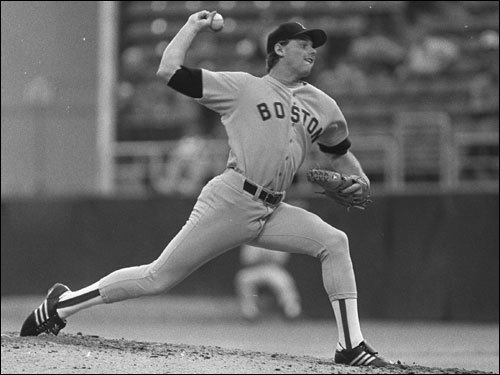
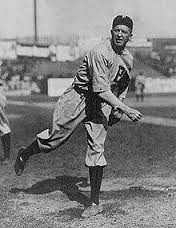
Early in life it was not evident that George Herman "Babe" Ruth would be a slugger of legendary proportions. He was an awkward-looking young man from the streets of Baltimore, where he grew up in the care of his father, a saloon-kepper, and later in a boys home, after his parents gave up trying to keep him out of trouble. It was in the boys home that Ruth learned to harness his great energy and play the game of baseball. He signed with the mionor league Baltimore Orioles in 1912 and by 1914 he was in the major leagues with the Boston Red Sox, as a pitcher.
The Red Sox were the best team in the American League, and a perfect place for Ruth to learn to be a major leaguer. In 1916 he got his first chance to pitch in a World Series and made the most of his one appearance. After giving up a run in the first inning, he drove in the tying run himself, then held the Brooklyn Dodgers scoreless for the next eleven innings until his team could score the winning run. In the 1918 World Series he continued his pitching heroics, running his series record to 29 2/3 scoreless innings, a mark that stood for forty-three years.
With the talented Sox, Ruth went 18-8 in 1915, 23-12 (with a league-leading 1.75 ERA and nine shutouts) in 1916, 24-13 (2.01 ERA) in 1917, and 13-7 in 1918. He was the winningest left-handed pitcher in baseball from 1915-1917. The Red Sox won the World Series in 1915, 1916 and 1918. Ruth's pitching mark was 89-46 with the Sox, but his booming bat was too loud to be heard only every four days. Red Sox manager Ed Barrow, at the suggestion of outfielder Harry Hooper, began playing the Babe in the outfield in-between his starts.
In 1918, Ruth led the American League with 11 home runs, despite playing just 59 games as an outfielder. The next season he started just 15 games on the mound and led the loop in homers again, with an unheard of total of 29. He was gaining attention with his home run trot, rounding the bases with what one observer noted were tiny "debutante" ankles. In 1919, he played 130 games and was now an everyday player. He seemed poised to lead the Red Sox to the top of the league for years to come. But, despite Ruth's obvious value as a slugger, he was dealt to the New York Yankees prior to the 1920 season, in a deal that haunted Boston owner Harry Frazee for years to come. Over the next 15 years, Ruth would hit hundreds of homers while helping the Yankees to the World Series seven times. The Red Sox did not win another World Series title for 86 years.
Crushed by his sale to the Yankees, Ruth was unsure of his future in New York. But his doubts failed to affect his performance in 1920. Ruth's 54 homers surpassed every other team in the majors except one. That same season, Ruth slugged an astonishing .847, a record that stood for more than 80 years. In 1920, the Yankees, coincidentally, became the first team to draw more than one million fans to a ballpark, more than double the attendance of any other club. As Yankee manager Miller Huggins said, "They all flock to see him," because the American fan "likes the fellow who carries the wallop."
As an encore in 1921, Ruth outdid himself, setting major league records with his totals of 59 homers, 457 total bases, 171 RBI and 177 runs scored. He had at this point in his career already hit more homers than anyone in baseball history. And he was only 26 years old. Off the field he was a superstar, the first real sports icon in American history. He did everything in a big way - he ate, he drank, he chased women, and he had a great time being "The Babe."
In 1922, Ruth's raucous ways began to catch up with him. He ignored Baseball Commissioner Kenesaw Mountain Landis's ban on barnstorming in the off-season and traveled with his own All-Star team. For his transgression, he was suspended for 39 days, missing the start of the regular season. In May, he threw dirt in an umpire's eyes, took off after a heckler in the stands, and when the crowd booed him, he stood on the dugout roof shaking his fist and yelling, "You're all yellow!" Once again he was suspended. In September he had another run-in with a fan, and was suspended again. He sat out nearly a third of the 1922 season and still hit 25 home runs, but he wasn't himself. In the World Series, the Yankees lost to the Giants and Ruth hit just .118.
Despite the terrible 1922 campaign, Ruth's arrival in New York signaled an era of success for the Yankees. After winning 95 games in 1920, the Yankees won the pennant in 1921 and 1922. After losing the World Series twice to the Giants, the Yanks finally won their first championship in 1923 - with new Yankee Stadium as the backdrop. Fittingly, it was dubbed "The House That Ruth Built," and the Babe blasted the first homer in the new stadium. The Yankees won the pennant again in 1926, and back-to-back World Series titles in 1927-1928. Ruth was a monster in the post-season, and he hit .516 with five homers, 11 RBI, 13 runs, and a 1.097 slugging percentage in the '27 and '28 Series combined.
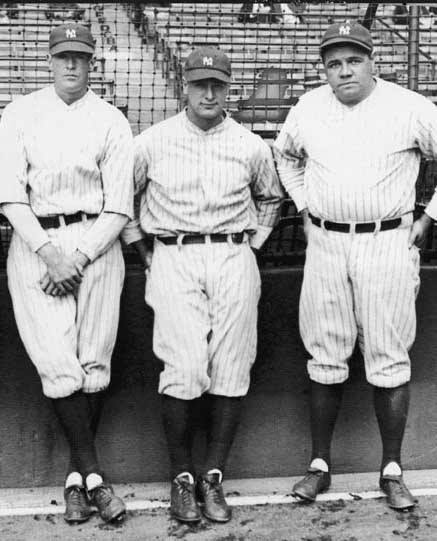
With the Yankees, Ruth teamed with first baseman Lou Gehrig to launch a dynasty that would dominate baseball. Starting with their first flag in 1921, the Yanks won 29 pennants in 44 years from 1921-1964. It all started with the acquisition of Ruth from the Red Sox.
Ruth reached his apex of stardom in 1927. Ruth belted a record 60 homers and established a mark that sluggers would aim at for years to come. The rotund slugger continued to knock the ball out of the park over the next few seasons, winning his sixth straight home run title in 1931. In 1932, the Yankees won their final title with Ruth, defeating the Cubs in the World Series, which featured Babe's famous "Called Shot." For the Babe it was his seventh World Series ring.
At the tail end of his career, Babe Ruth's determination to become a major league manager prompted him to turn down an offer from the Yankees to manage their top minor league team, the Newark Bears. Instead, in the spring of 1935 he joined the worst team in the National League, the Boston Braves, as an "assistant manager" and active player, lured by unsubstantiated overtures that he might become their manager the next season. As a player he was all but finished. He reported to the team grossly overweight, which threw his timing off at the plate and made him appear a buffoon in the outfield. There was a slanting terrace in left field in Cincinnati that acted as a warning track near the concrete left-field fence. When Ruth chased fly balls near it, he would stumble, fall, or catch balls in what appeared to be self defense.
On May 25, 1935, at Forbes Field in Pittsburgh, Ruth flashed his greatness one final, glorious time. That afternoon, he hit three home runs; the last one, the first ball ever to be hit completely out of that park! He crushed the ball so convincingly that the Pirate players simply stood and watched it disappear behind the stands. The crowd of 10,000 let loose a mighty roar as the old slugger hobbled around the bases. When he rounded third, the pitcher, Guy Bush, tipped his cap to the Babe, who smiled and saluted back. It was the last home run he would ever hit, number 714. At that point in baseball history, no other player had ever hit even half that many. It was a record that would stand for nearly four decades.
A week later, Ruth announced his retirement from baseball. From that time until the day he died, he waited and waited for a call from some team, any team, to become a major league manager. A call that would never come.
Ruth's achievements were remarkable. Thirteen times he drove in over 100 runs, with a high of 171 in 1921. He hit over .300 seventeen times, topping out at .393 in 1923. Twelve times he led the majors in home runs and thirteen times he led the majors in slugging. His .690 career slugging average remains the highest in history. When he retired, his 714 home runs, 2,174 runs, 2,211 RBI and his 2,056 walks ranked at the top of the all-time list.
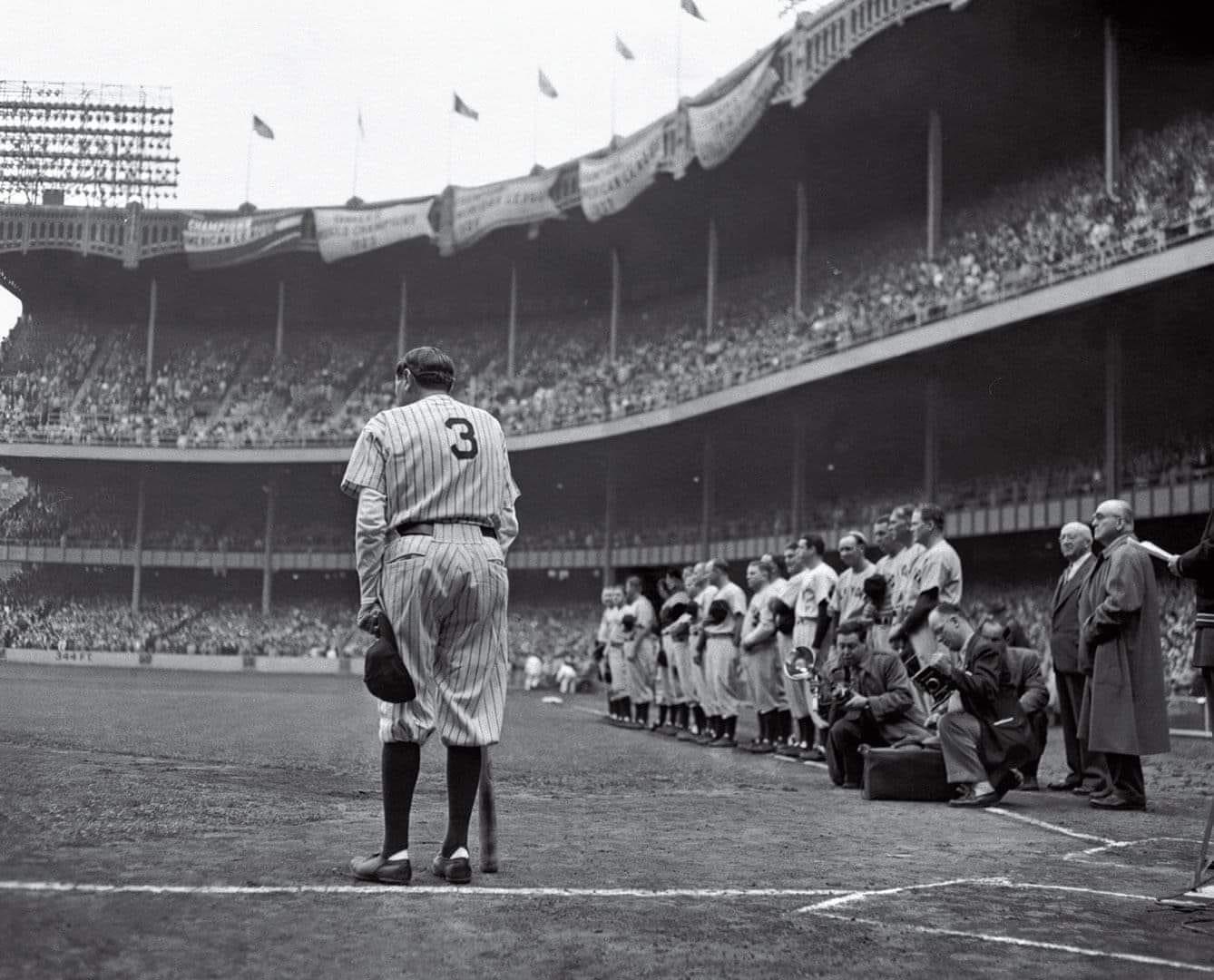
June 13, 1948, was chosen to celebrate the twenty-fifth anniversary of Yankee Stadium. Babe Ruth, the man who had hit the first home run in that stadium was ill with throat cancer, but was determined to be on hand. His wife and doctors kept the mortal diagnosis from him, but he knew the end was near. "The termites have got me," he told Connie Mack when Mack visited him. Surgery had stemmed the disease for a short time, but had damaged his larynx, shrinking his exuberant voice to an old man's rasp.
The clubhouse was lined with his old teammates and survivors of the 1923 team. They played a two inning exhibition game against veterans from other years. Ruth was too exhausted to take part. Friends helped him into his old uniform, which hung on his frail, thin body like a tent. It was raining that day and someone put a camel's hair coat over his shoulders. One by one, his old teammates were introduced, to booming cheers from the adoring crowd. Finally, announcer Mel Allen's voice called him to home plate. He shuddered out of his topcoat and using a bat (Bob Feller's) as a cane, walked out to home plate on the wave of a tumultuous ovation. When it subsided, he managed to croak a few words into the microphones, expressing his pride at hitting the first home run there and acknowledging the presence of some of his friends.
Soon he was back in the hospital, where he signed autographs, watched baseball on television, listened to his wife read him some of the hundreds of letters he got every day, and did his best to keep up a jovial front when visitors came to call.
Babe Ruth died of cancer at 8:01 p.m., August 16, 1948. He was only fifty-three years old. Over 100,000 fans paid their respects at Yankee Stadium, where he lay in rest. Grieving fathers held up their sons for a final look at the face of the greatest player in baseball history. Ruth's old teammates volunteered as pallbearers and the flag at Yankee Stadium flew at half-mast.
Many of Babe Ruth's records have been broken in the years since his playing days ended. But no one has ever come close to diminishing his legacy. His tremendous achievements and larger than life personality changed the face of the sport forever. There will never be another Babe Ruth.
Jail Stripes to Pinstripes
On the morning of June 8, 1921, Ruth was arrested for speeding in New York City. Sitting in jail while he arranged for his release, Ruth was allowed to change into his uniform in his cell. He arrived at Yankee Stadium in time to play in New York's 4-3 victory over Cleveland.
Ruthian Feats
Three home runs in a World Series game twice... The Babe hit 340 solo home runs, 252 two-run shots, and 98 three-run taters. He also slugged 16 Grand Slams... 51% of his homers came with a man or men on base... He hit 16 homers in extra-innings, 10 inside-the-park variety, and one as a pinch-hitter (in 1916 with the Red Sox)... 459 of his career regular season homers came against right-handed pitchers, or 64%. 219 times he blasted a circuit blow off a lefty... In six seasons with the Red Sox he hit 49 homers, 11 in Fenway Park, 38 on the road. With the Yankees in 15 seasons, he slugged 659 long blows, 334 at home, 325 on the road... Ruth hit at least one home run in 12 different ballparks... 72 times, Ruth slugged a pair of homers in a game, a major league record that still stands. He connected for three homers on May 21, 1930, with New York, and with the Braves on May 25, 1935, including the final homer of his career, off Pirate Guy Bush... His 686 home runs as an outfielder are the most by any player at any position. He hit 15 long balls as a pitcher... Collected RBI in 11 consecutive games in 1931... Stole home 10 times... Won two legs of the Triple Crown seven times (1919, 1920-1921, 1923-1924, 1926, 1928)... First player to hit three home runs in a single game in the AL and NL... 11 consecutive games with at least one extra-base hit (August 28 to September 8, 1921) the second longest streak in major league history... Holds the all-time single season record for most total bases (457 in 1921) and times reached base (375 in 1923)... Three times he had 4 extra-base hits in a game... Ruth had six five-hit games in his career... Scored five runs in a game twice... On April 20, 1926, he drove in eight runs, his career high... Collected more RBI than games played in six seasons. (1921-27-29-30-31-32).
Most Walk-Off Home Runs, Career
Jimmie Foxx……..12
Mickey Mantle......12
Stan Musial........12
Frank Robinson.....12
Babe Ruth..........12
Tony Perez.........11
Dick Allen.........10
Harold Baines......10
Reggie Jackson.....10
Mike Schmidt.......10
The Curse of the Bambino
Babe Ruth may have become the greatest player in Boston Red Sox history, if not for the greed and short-sightedness of one man. In 1917 the team was purchased by H. Harrison Frazee, a high-living, hard-drinking theatrical producer who loved baseball but loved Broadway more. He saw the Red Sox as a means of financing his theatrical operations, and began selling off all of his best players to Colonel Jacob Ruppert, owner of the New York Yankees, to raise cash for a number of Broadway ventures. Ruth became victim to this practice in 1920, when Frazee sold him to Ruppert for $125,000 and the promise of a $300,000 personal loan with which to finance his plays. Fenway Park was put up as security for the loan. The Red Sox have never recovered from the loss of Ruth. They had won five of the first fifteen World Series, but would not play in another for 28 years, and did not win the title again until 2004. Red Sox fans refer to this as "The Curse of The Bambino."
Credit Where Credit is Due
Most historians give the credit for Ruth's move to everyday outfield status to Boston manager Ed Barrow. In fact, the idea was first mentioned seriously by Red Sox Hall of Fame outfielder Harry Hooper, who saw the value in the Babe's bat and glove in the outfield on a regular basis. Barrows does deserve the credit for going through with the switch.
Description
Like many players of his era, Ruth was extremely superstitious. He believed in the power of four-leaf clovers, horseshoes and rabbit's feet. He also kept a mascot with him for several years, batboy Eddie Bennett.
Scouting Report
In 1921, Columbia University had Ruth undergo a series of tests to determine his athletic and psychological capability. Here are some of their findings, from an article by sportswriter Hugh Fullerton in Popular Science Monthly:
The tests revealed the fact that Ruth is 90 per cent efficient compared with a human average of 60 per cent. That his eyes are about 12 per cent faster than those of the average human being. That his ears function at least 10 per cent faster than those of the ordinary man. That his nerves are steadier than those of 499 out of 500 persons. That in attention and quickness of perception he rated one and a half times above the human average. That in intelligence, as demonstrated by the quickness and accuracy of understanding, he is approximately 10 per cent above normal.
Where He Played
Ruth was a right fielder mostly, though he did play a few seasons in left early in his career. Of course, he also pitched. In 490 at-bats as a pitcher, Ruth hit .304 with a .504 slugging percentage. He scored 75 runs, had 34 doubles, 11 triples, 15 home runs, and drove in 73... According to David Vincent, the guru of home run stats, Ruth hit 354 homers as a right fielder, and 313 as a left fielder. He and Ernie Banks (shortstop and first base) are the only players to hit as many as 300 HR at two positions.
Born
George Herman Ruth was born on February 6, 1895, in Baltimore, MD.
Died
August 16, 1948, New York, NY
Batted: Left
Threw: Left
Major League Debut
7 11,
Nine Other Players Who Debuted in 1914
Babe Ruth
Harry Heilmann
George Burns
Everett Scott
Red Faber
Sad Sam Jones
Dolf Luque
Jack Tobin
Braggo Roth
Nicknames
The Bambino,The Sultan Of Swat
Also known as "The Colossus of Clout," "The Wali of Wallop," "The Wazir of Wham," "The Maharajah of Mash," "The Rajah of Rap," "The Caliph of Clout," and "The Behemoth of Bust." Ruth was first called "Babe" by teammates on the Baltimore Orioles, because of his boyish face and his young age.
Uniform Numbers
#3 (1929-1935)
Similar Players
Are you kidding?
Related Players
Lou Gehrig, Roger Maris, Henry Aaron, Mark McGwire, Barry Bonds, Rickey Henderson
| Hall of Fame Voting |
| Year |
Election |
Votes |
Pct |
| 1936 |
BBWAA |
215 |
95.1% |
|
No-Hitter
6/23/1917: For BOS (A) vs. WAS (A), 4-0 at BOS. 0 innings pitched.
Post-Season Appearances
1915 World Series
1916 World Series
1918 World Series
1921 World Series
1922 World Series
1923 World Series
1926 World Series
1927 World Series
1928 World Series
1932 World Series
The Pitches He Threw
Ruth's first professional catcher, Ben Egan, had this to say about Babe the pitcher: "Babe knew how to pitch the first day I saw him. I didn't have to tell him anything. He knew how to hold runners on base, and he knew how to work on the hitters, so I'd say he was a pretty good pitcher on his own.
Egan caught the Babe with the Baltimore Orioles in 1914.
Post-Season Notes
Ruth holds the record for the longest complete game victory in World Series history. In 1916, Ruth went 14 innings to defeat the Brooklyn Dodgers... Babe and the Yankees were back in the World Series in 1932, playing the Chicago Cubs. There was no love lost between the Babe and Chicago fans. They jeered and spat upon him and his wife as they entered and left their hotel. As the Series progressed into its third game, the stage was set for one of the most remembered events in baseball history. In the first inning, Ruth hit a three-run homer off pitcher Charlie Root. When he came to bat again in the fifth, the crowd and the Chicago bench released a torrent of abuse upon him. Babe waved his arm and shouted something, though due to the loud noise, no one heard exactly what he said. Whether he was gesturing toward the Cubs bench, to Root or the fence beyond is anyone's guess. But what happened next is beyond doubt. On Root's next pitch, Ruth swung mightily and connected with a home run over the center field fence, farther than any home run had ever been hit at Wrigley Field. Had he really called his shot? He was evasive when questioned, responding with, "Why don't you read the papers? It's all right there." Years later a film of the event showed that the Babe was probably not signaling to the bleachers, but rather to his tormenters – the Cubs bench. Nevertheless, the legend of "The Called Shot" remains.
Awards and Honors
1923 AL MVP
Milestones
- September 24, 1920: 100th HR...
- May 12, 1923: 200th HR...
- September 8, 1925: 300th HR...
- September 2, 1927: 400th HR...
- August 11, 1929: 500th HR... Off Willis Hudlin, in the 5,801st at-bat of his career.
- August 21, 1931: 600th HR...
- July 13, 1934: 700th HR...
Batting Feats
- October 11, 1923: 2 HR in WS Game...
- October 6, 1926: 3 HR in WS Game...
- September 30, 1927: 60th HR...
- October 9, 1928: 3 HR in WS Game...
- May 21, 1930: 3 HR...
- October 1, 1932: 2 HR in WS Game...
Injuries and Explanation for Missed Playing Time
Early in the 1920 season, Ruth was filming a movie titled Headin' Home. During the shooting on location in New York, Ruth was stung by an insect and his wrist swelled. A physician had to make an incision to drain fluid and reduce the swelling. Ruth missed six games. This information comes from SABR member Jim McLauchlin.
Hitting Streaks
26 games (1921)
Transactions
Sold by Boston Red Sox to New York Yankees (January 3, 1920).
Home Run Facts
In 10 seasons together, Ruth and Lou Gehrig homered in the same game 72 times, and in the same inning 19 times. The two combined as teammates for 783 homers (434 for Babe, 349 for Lou), the highest total ever, until Henry Aaron and Eddie Mathews…
1919 (4), 1922 (1), 1925 (1), 1926 (1), 1927 (2), 1929 (3), 1930 (1), 1931 (1), 1932 (1), 1934 (1). (16 total)
In 1927 he hit a grand slam in consecutive games, September 27th and 28th.
Hall of Fame Artifacts
The Hall of Fame has Babe Ruth's bowling ball, shoes and bag. They also have his jersey, several of his bats, his locker from Yankee Stadium, and his spikes. Also in the Museum's collection are products endorsed or featuring Ruth, including underwear that were sold in the 1920s.
Matchup BigData
Ruth blasted A's hurler Rube Walberg for 17 home runs in his career, one of 216 different pitchers he victimized.
Trivia Question
When did Babe Ruth star in the movies?
Trivia Answer
According to SABR member Rob Edelman: In 1920, Babe Ruth played a character known simply as "Babe" in HEADIN' HOME. Back then, Ruth could be cast as a clean-living, mother-loving all-American boy. The "Babe" in HEADIN' HOME is a character who, off the field at least, is quite unlike the man who played him: a simple, humble chap, residing with his mother and kid sister in a small town. Babe passes his spare time chopping down trees and fashioning them into baseball bats. He prefers quiet evenings enjoying his mother's home cooking to attending town socials. His shyness prevents him from expressing his feelings to the girl he loves.
In other words, the "Babe" played by Ruth in HEADIN' HOME is a mythical
all-American boy-hero.
By 1927, Ruth's real-life off-the-field carousing had become such public
knowledge that NEW YORK TIMES sportswriter/columnist John Kieran could
casually refer to him as the "Playboy of Baseball" in a piece written the
day after the Bambino hit his record-setting 60th home run. So he could be
caricatured as egocentric (in SLIDE, KELLY, SLIDE) and as boisterous (in
CASEY AT THE BAT). I would say that the SLIDE, KELLY, SLIDE character is
derisive; while the CASEY AT THE BAT character is far less harsh, his
interest in beer and chorus girls does not fit that of an all-American
"hero."
Also in 1927, the Bambino starred in a second feature film, a comedy titled
BABE COMES HOME. Here, his character's name is lengthened to "Babe Dugan."
He enacts a role that is more reflective of the real Bambino: a baseball
star with an affinity for dirtying his uniform with tobacco stains.
Unfortunately, this film is lost; I would love to see it. Anyway, according
to plot synopses of the film, "Babe Dugan" becomes engaged to Vernie (Anna
Q. Nilsson), the laundress who cleans his uniforms. She sets out to reform
him. He gives up tobacco in the name of love, but slumps badly and is
benched. After coming to understand her beloved's need for tobacco, Vernie
relents and gives the big guy a plug of the stuff during an important game.
Babe is revitalized, just as Popeye the Sailor is after chugging down a can
of spinach, and he wins the contest with a homer. There is a point to all
this: If the Babe were not allowed to be, well, the Babe, he just might not
have been able to belt all those real-life homers.
Finally, the WARMING UP citation comes from a lengthy, mostly negative
review of the film, published in VARIETY on June 27, 1928. (This film also
is lost.) Here is the full paragraph: "The (storyline) concerns the trials
and tribulations of Bee Line Tolliver (Mr. Dix), a rube pitcher who wanders
onto the ball grounds where the Yanks are training in Florida. McRae, the
slugger for the Yanks, supposed to be a prototype of Babe Ruth, and whose
only resemblance to the immortal Bamb is under the arms, decides to trick
the rube with the 'iodine' bit. This is a goofy invention of the author
whereby the rooky is tricked into thinking he has beaned the batter. The
latter takes a prop fall and the players sneak a dab of iodine on his
forehead."
As the story plays itself out, Tolliver is the hero and McRae is his
nemesis. Later on in the review, McRae is referred to as the film's "heavy." "Mr. Dix" is Richard Dix, the film's star.
All-Star Selections
1933 AL
1934 AL
Replaced
Ruth entered the Red Sox rotation in place of Ray Collins, the lefthander who had helped anchor the 1914 staff. By 1918, Ruth had begun to see action in the outfield. Previous Sox flychasers whom he took playing time from included: Chick Shorten, Tilly Walker and Jimmy Walsh. But it was really the exit of Duffy Lewis that helped open the way for Ruth to become an everyday outfielder. In New York, Ruth and Lewis met again, with the same result. The Yankee outfield in 1919 had been Lewis, Ping Bodie and Sammy Vick. In 1920 Ruth and Bob Meusel grabbed playing time, while Bodie and Lewis were relegated to fighting over the third spot. It wasn't until 1923 that the pinstripers had a three man outfield in place with Meusel, Ruth and Whitey Witt.
Replaced By
That unfortunate task fell to George Selkirk, a one-time wrestler, who decided to try his hand at baseball and found himself in the major leagues with the Yankees after Earle Combs was hurt in 1934. In 1935, after Ruth exited for Boston, Selkirk took his spot. The team didn't make it easy on him, giving him Babe's old #3 uniform number and his third spot in the lineup. Selkirk was a left-handed batter more familiar with left field than right. Longtime minor league teammate Myril Hoag battled him for the open outfield spot created by Ruth's departure, but Selkirk, nicknamed "Twinkletoes", won out. In '35, he hit .312 but slugged just 11 homers. In 1936, he upped it to 18 with 107 RBI, but the numbers were too low for a Yankee outfielder. By 1937 he was pushed out by Joe DiMaggio's arrival, and used sparingly until World War II ended his career.
Best Strength as a Player
Power
Largest Weakness as a Player
Judgement on the basepaths…
Worst Stolen Base Percentage, All-Time
(Minimum 200 attempts)
Lou Gehrig… 50.2% (102-for-203)
Babe Ruth… 51.3% (123-for-240)
Greg Gagne… 52.9% (108-for-204)
Charlie Jamieson… 54.4% (131-for-241)
Pete Rose… 57.1% (198-for-347)
Well, you have to be a pretty good player to attempt 200 steals. Ruth was known for his hubris - he thought he was faster than he was. Gehrig was said to be quick, but for whatever reason he stole bases at a poor clip. The other three players: Gagne, Jamieson and Rose, couldn't afford to be poor base stealers as much as Babe and Lou could. Had Rose never tried to steal a single base in his career, he may have scored the 80 or so runs he needed to catch Ty Cobb on the all-time list.
Learn More about Babe Ruth
Search Amazon.com for Books about Babe Ruth ⇒
Search for Babe Ruth at Google ⇒
View a map of his hometown at Mapquest ⇒